
Most IHM guidance is written from the regulator’s side of the table. This one is written from yours. When a Port State Control (PSC) officer or a class surveyor sits down to look at your Inventory of Hazardous Materials, what do they actually ask for — and what trips vessel teams up most often?
The reassuring part: an IHM inspection is rarely about catching you out on chemistry. It is about documentation discipline. Almost every finding comes down to a record that should exist and does not, or a date that has quietly slipped past.
Quick answer
PSC and class reviewers usually check whether the certificate is current, Part I is populated and maintained, changes since the last survey are recorded, and supplier evidence can be produced quickly.
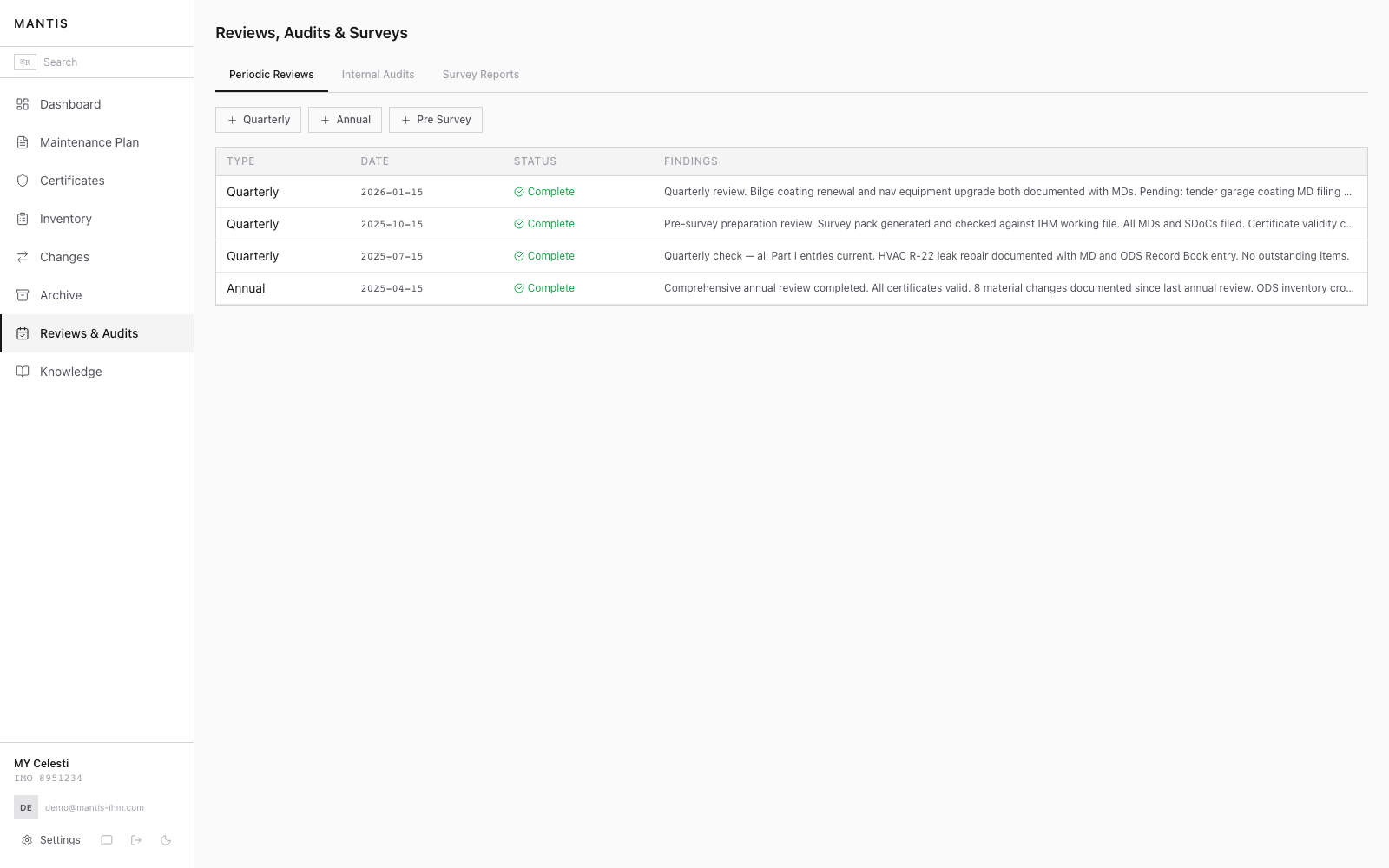
The documents an inspector typically requests
In a Convention or EU port, an officer reviewing your IHM will usually want to see:
- The certificate and its validity dates — under the Hong Kong Convention, the International Certificate on the Inventory of Hazardous Materials (ICIHM); under the EU Ship Recycling Regulation, the Inventory Certificate or Statement of Compliance. (We explain the difference between the two here.)
- The inventory itself — and in particular, that Part I is populated, not blank. An empty or token Part I is one of the clearest signals that an IHM was drafted once and never maintained.
- Change records since the last survey — evidence that the inventory has been updated when materials changed.
- MD/SDoC documentation — Material Declarations and Supplier’s Declarations of Conformity behind any material change, typically from a refit or equipment replacement.
- Supporting evidence access — the declarations, reports, and files behind the Part I entries.
The findings that come up most often
Across vessels, the same handful of issues account for most IHM-related findings:
- Certificate expired. A renewal survey was missed, and the certificate lapsed. This is purely a calendar problem — and entirely avoidable with a tracked renewal date.
- A known refit with no change records. The vessel visibly had work done — new insulation, replaced refrigeration, a re-fit-out — but the inventory was never updated to match. To an inspector, this is the most telling gap, because the work is obvious and the paperwork is not.
- Missing contractor documentation. A material changed, but the Material Declaration or SDoC from the contractor who did the work was never collected. Getting it months later, after the yard has moved on, is hard.
- Weak evidence trail. The entry exists, but the supporting declaration, service report, or supplier document is missing.
Notice what these have in common: none of them are about the original survey being wrong. They are about the inventory not being kept alive between surveys. The IHM is a living document, and inspection is where that shows.
How to be ready — a pre-arrival check
You do not need a survey to be inspection-ready. You need to be able to answer four questions before your vessel reaches a Convention or EU port:
- Is the certificate current, and is the next renewal date in the calendar?
- Has any work in the past five years changed a controlled material without a matching inventory entry? A refit, a refrigerant system change, a replaced battery bank.
- Do you hold the MD/SDoC documentation for that work?
- Can you produce the evidence behind the Part I changes quickly?
If you can answer all four with confidence, an IHM inspection is a short, calm conversation. If any answer is “I’m not sure,” that is the thing to close before the port, not after the officer is aboard.
The detailed version of this — the full pre-survey walk-through — is in our renewal survey preparation checklist.
Evidence pack checklist
| Pack item | What it proves |
|---|---|
| Current certificate | The IHM has an active verification/certification route. |
| Current Part I | The vessel has a maintained operational inventory. |
| Change log | Material changes were reviewed since the last survey. |
| MD/SDoC/SDS evidence | The entries are supported by supplier documentation. |
| Open gap list | Known missing items are visible and being closed. |
Where software changes the picture
The four questions above are exactly the state a purpose-built IHM workspace keeps visible at all times: certificate dates tracked and counting down, change records logged against the events that triggered them, and MD/SDoC stored against each change. Instead of reconstructing the answer before each port call, you read it off a dashboard.
For the operational process between inspections, see maintaining IHM Part I.
Related reading:
This article is general guidance, not a statement of the enforcement procedures in any particular jurisdiction. For the consequences and procedures that apply to your vessel, refer to your flag State administration or the relevant regional Memorandum of Understanding (Paris MOU, Tokyo MOU, and others).
Answer inspection questions without rebuilding the pack.
MANTIS is IHM compliance software. It tracks certificate expiry and survey intervals, logs Part I changes, stores MD/SDoC documentation, and generates survey-ready exports for class society review.
Request demo