IHM Compliance Management · HKC + EU SRR

IHM management,
made effortless.

The IHM Maintenance Plan software built for superyachts. Generate or upload your maintenance manual, keep Part I and the change log current, and compose a survey pack in one click — so your vessel is always survey-ready.

No credit card · Free during beta · Limited spaces

app.mantis-ihm.com / M·Y Celesti / Dashboard
MANTIS dashboard showing vessel IHM status and recent activity
app.mantis-ihm.com / M·Y Celesti / Maintenance Plan
MANTIS Maintenance Plan — the generated IHM governing document, with version control and DP sign-off
app.mantis-ihm.com / M·Y Celesti / Part I Inventory
MANTIS Part I hazardous materials inventory table
app.mantis-ihm.com / M·Y Celesti / Certificates
MANTIS certificate tracking with expiry status
app.mantis-ihm.com / M·Y Celesti / Reviews & Audits
MANTIS reviews and audits log
Dashboard
By a working Chief Engineer — built by someone who's lived the survey scramble Structured around the Hong Kong Convention & EU SRR Free during beta · grandfathered pricing for life
The problem

Your IHM is certified. Now comes the part most vessels get wrong.

Vessels in scope of the Hong Kong Convention and EU SRR establish their IHM through an initial hazardous-materials survey. Most handle that. What follows is where it falls apart.

The IHM Maintenance Plan requires recording every material change throughout the vessel's operational life — not just at survey time. Most vessels manage this with a server folder and a spreadsheet that drifts further from reality every refit.

MANTIS is your IHM Maintenance Plan — the record that stays current between surveys.

Without MANTIS
Spreadsheet out of date since the last refit
Three versions. Nobody knows which is current.
Surveyor visit becomes a two-week scramble
Chasing SDoCs and MDs that should have been filed months ago.

With MANTIS
One source of truth, always current
Change logged the day equipment comes aboard.
Survey pack in one click, any time
Composed the way a surveyor expects to read it.
A day in the life

From "equipment aboard" to "survey-ready" — without the spreadsheet.

01
Equipment comes aboard
A new pump, paint batch, or refrigerant — anything carrying hazardous materials.
02
Log the material change
One entry on the bridge or in the engine room — date, item, location.
03
Attach the MD / SDoC
Supplier docs filed against the item the day they arrive — never chased later.
04
Part I updates itself
The inventory and immutable change log stay current automatically.
05
Survey pack, one click
When the surveyor's coming, the whole pack composes itself — lead document first.
What MANTIS does

Everything your IHM Maintenance Plan requires.

Built for nothing else. No adjacent features, no bloat. Parts II and III are included as good practice — hideable per vessel where you don't track them.

Maintenance Plan

The governing document, built in

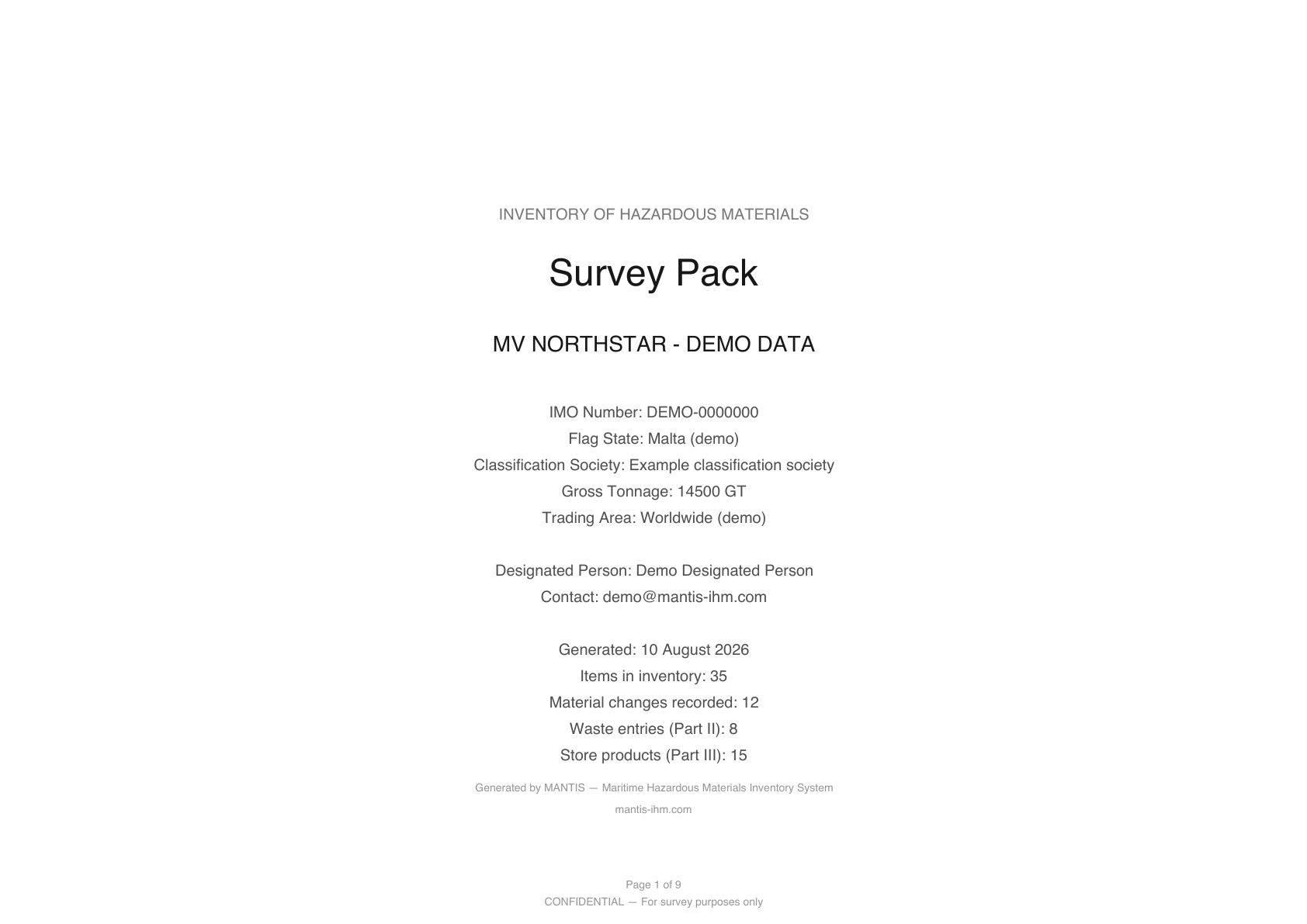
Upload your existing IHM Maintenance Manual, or generate a vessel-specific one from your live data — Part I inventory, MD/SDoC archive, and change log composed into a single manual. Record the DP's sign-off to lock the version; regenerate at each audit.

Part I · MD/SDoC archive · Change log · DP sign-off
Part I

Hazardous Material Inventory

Track every hazardous material. Build manually or import from your existing Excel IHM.

Part II

Waste Stream

Index operational waste by MARPOL Annex. Attach evidence. Track ODS disposal.

Part III

Operational Stores

Manage consumables. Version Safety Data Sheets. Table A/B flagged automatically.

Certificates & Survey

Certificate tracking + one-click survey pack

ICIHM, EU Inventory, Statements of Compliance — with expiry alerts and full version history. Then compose a survey pack in one click, with your adopted Maintenance Plan as the lead document, organised the way a surveyor expects to read it.

Expiry alerts · Version history · Surveyor-ordered PDF
Audit Trail

Immutable Change Log

Every material change with MD and SDoC references. A complete, immutable audit trail.

For management companies

Your DPA liability spans every vessel. So does MANTIS.

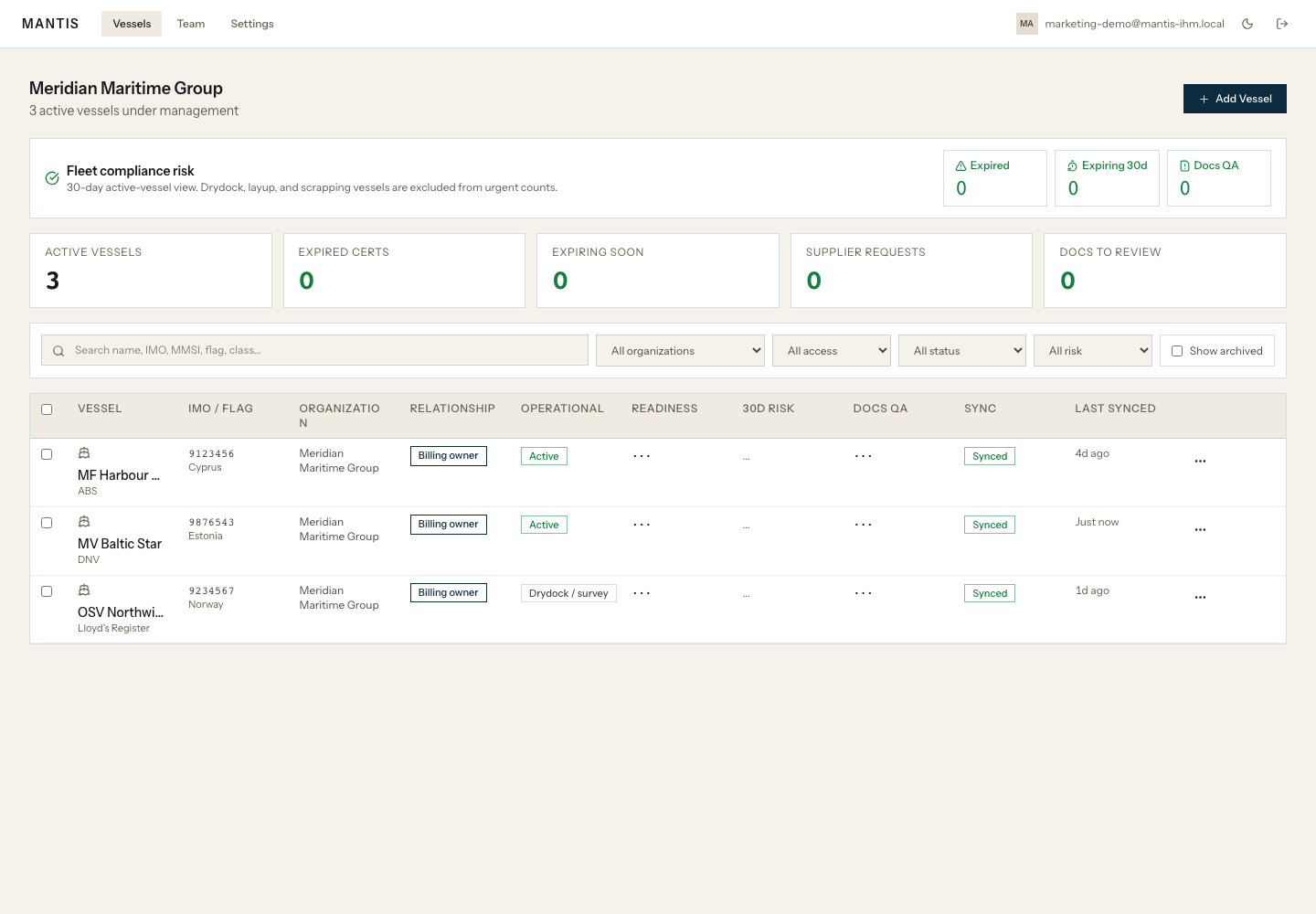
Chasing each vessel for IHM status before a class survey is a liability. MANTIS gives you a live IHM status view across your whole fleet — which vessels are up to date, which have outstanding items, which have supplier documents pending. When an auditor asks, the answer is one click away.

Fleet dashboard
Every vessel's IHM status in one view — readiness, outstanding items, upcoming surveys.
Role-based access
CE updates, DPA approves, surveyors invited read-only — enforced at the database layer, not just hidden in the UI.
Consolidated billing
One invoice per fleet, per-vessel pricing, add vessels as the fleet grows.
app.mantis-ihm.com / Velmara Yacht Management / Fleet
MANTIS fleet dashboard for a management company showing 12 vessels with IHM status, certificate counts, and survey readiness
Regulatory coverage

Structured around the regulations. Independent of any class society.

MANTIS organises your IHM records around the full regulatory framework, so they line up with what a surveyor expects to see — whoever surveys your vessel. No approval implied, no lock-in.

  • Hong Kong Convention
    MEPC.379(80) · MEPC.405(83) · In force June 2025
  • EU Ship Recycling Regulation
    Regulation (EU) 1257/2013 and amendments
  • Table A & B Substance Database
    Full reference · Automatic flagging · Searchable
  • MARPOL Annex References
    Part II waste stream · ODS disposal tracking
Free guide

The IHM Maintenance Handbook for superyachts.

The six core maintenance activities, explained — certificate management, Part I/II/III workflows, change recording, and survey preparation. Based on MEPC.379(80), written by a working Chief Engineer.

  • The 7-step material change workflow
  • Quarterly and annual review checklists
  • The 8-item pre-survey checklist
Get the free handbook →

Read online, save as PDF. No cost, no software required.

Why we built MANTIS
"We built MANTIS because we'd lived the problem."

Dylan Wentink — Founder, Navio Maritime OÜA working Chief Engineer with ten-plus years across refit, world cruising, and new build. MANTIS is built by Navio Maritime, a maritime software company for superyachts — by people who have chased SDoCs, filed MDs, and sat across from a surveyor with records that weren't ready, for the crews who do it next.

Pricing

Free during our beta.

Every feature, every vessel, no credit card. We're hardening the product with our first cohort — beta users get grandfathered pricing for life when we move to paid.

Beta cohort
Free
during beta

Real captains, CEs, and DPAs hammering on a tool built for them. Join the cohort that shapes what gets built next.

Join the beta

Managing a fleet? Contact us — fleets welcome in the beta →

From the blog

IHM compliance insights

Read the blog →
Read the blog →
FAQ

Frequently asked questions

What the regulations require for superyachts — and how MANTIS helps you keep on top of it.

IHM basics

What is an Inventory of Hazardous Materials (IHM)?
An IHM is a controlled document listing the hazardous materials built into a vessel, maintained throughout its operational life so they can be managed safely when the ship is recycled. It has three parts: Part I (structure and equipment), Part II (operational wastes) and Part III (stores). How the three parts differ →
Why does the IHM matter?
Two regulations make it mandatory for vessels of 500 GT and above: the IMO Hong Kong Convention (in force 26 June 2025) and the EU Ship Recycling Regulation 1257/2013. Beyond the legal requirement, a current IHM keeps surveys and port-state inspections straightforward and protects everyone who later works on the vessel.
What regulations does MANTIS cover?
MANTIS is structured around the Hong Kong International Convention, EU Regulation 1257/2013 on ship recycling, and the 2023 IHM Guidelines (IMO MEPC.379(80), as amended by MEPC.405(83) in 2025), including the Table A and B substance lists. It helps you keep records against those rules — your class society and crew own compliance.

Do I need one?

Which vessels need an IHM?
Vessels of 500 GT and above. The EU Ship Recycling Regulation also reaches any-flag vessels of 500 GT+ that call at an EU port or anchorage (Art. 12), so for a yacht in that size class visiting Europe an IHM is effectively unavoidable. Confirm your exact obligations with your flag or class. Does my yacht need one? →
I'm not EU-flagged — why does the EU regulation apply to me?
Because the EU SRR applies to any flag of 500 GT and above when you call at an EU port or anchorage (Art. 12) — you carry a flag-issued Statement of Compliance plus Part I of the IHM. Red Ensign (UK) yachts fall under the separate UK SRR and are treated as third-country flag at EU ports.
Does it matter whether my yacht is private or commercial?
Scope is set by gross tonnage and where you trade, not by whether the yacht is private or commercial — a 500 GT+ yacht calling at EU ports is in scope either way. Warships and government non-commercial ships are excluded. Your flag administration can confirm any vessel-specific nuance.
What are the deadlines?
The EU SRR onboard-compliance date for existing ships was 31 December 2020 and is already in force. Under the Hong Kong Convention, existing ships need their IHM documentation by their first renewal survey on or after 26 June 2025, fully harmonised with other statutory certificates by 26 June 2030. The 2030 deadline explained →
We're building a new yacht — when does the IHM start?
For new builds, Part I of the IHM is compiled during design and construction and is in place from delivery, drawing on Material Declarations collected from the yard and suppliers. Starting it during the build is far easier than reconstructing it later from incomplete records.
Our existing yacht has no IHM yet — what now?
Existing vessels compile Part I retroactively through a hazardous-materials survey — a visual and sampling check, supported by build records where they exist — then maintain it from there. Older yachts with thin documentation can still be brought into line. IHM for older yachts →

What's in an IHM

What's the difference between Part I, II and III?
Part I lists hazardous materials in the ship's structure and equipment and is maintained throughout the vessel's life. Part II covers operationally generated wastes and Part III covers stores — both are only compiled when a decision to recycle is taken. In service, Part I is the focus.
What are Table A and Table B materials?
Table A covers prohibited or restricted substances — such as asbestos, PCBs, ozone-depleting substances and certain anti-foulings. Table B covers materials that must be listed if present above threshold, such as some heavy metals. The full lists and threshold values are set in the IMO IHM Guidelines (MEPC.379(80)). Free IHM handbook →
Do I need to maintain Part II and Part III now?
No — Parts II and III are only compiled when you decide to recycle the vessel. During the operational life, Part I is what you keep current. MANTIS lets you hide Part II and III per vessel if you don't track them, and switch them back on later.

Surveys & certificates

Will I get a certificate or a Statement of Compliance?
It depends on your flag. EU-flag (and Hong Kong Convention party-flag) vessels carry a ship-specific Inventory Certificate / ICIHM; non-EU, non-party flags carry a flag-issued Statement of Compliance. Each is supplemented by Part I of the IHM (EU SRR Arts. 9 and 12). ICIHM vs Statement of Compliance →
Who issues the certificate?
Your flag administration, or a Recognized Organization authorised by it — in practice, your classification society. The surveyor verifies that Part I reflects the actual vessel before the certificate or Statement of Compliance is issued.
How often is the IHM certificate renewed?
Renewal surveys take place at intervals not exceeding five years, in line with the vessel's other statutory certificates. Between renewals you keep Part I current as materials change; the renewal survey checks the inventory still matches the ship. Preparing for the renewal survey →
What happens during the survey?
The surveyor checks that Part I of the IHM reflects the actual vessel — for existing ships, Part I is first established through a hazardous-materials survey (visual inspection plus sampling where a material can't be confirmed by eye). Keeping your records current makes this straightforward.
How long does the survey take?
It varies with the vessel's size, age and how complete the existing documentation is — there's no fixed figure, and a yacht with good build records and a current Part I is quicker than one reconstructed from scratch. Your class society or IHM provider will scope it.

Keeping it current

Who is responsible for keeping the IHM up to date?
The shipowner, throughout the vessel's operational life — typically by appointing a designated person and building an IHM maintenance procedure into the safety management system. On yachts the designated person is often the shore-based manager or DPA rather than a rotating chief engineer. The designated person's role →
What are Material Declarations (MD) and Supplier's Declarations of Conformity (SDoC)?
A Material Declaration states a product's hazardous-material content; a Supplier's Declaration of Conformity confirms the MD is accurate. You collect both for in-scope purchases and file them as the evidence behind your Part I entries. Managing MD/SDoC paperwork →
Do I need an MD/SDoC even if a product has no hazardous materials?
Yes. The MD/SDoC is your evidence that the item is clear, so you collect them for all in-scope purchases regardless of whether hazardous materials are present. Missing declarations are a common gap surveyors ask about.
We replaced a part with an identical one — do we update the IHM?
No — identical replacement parts and coatings are exempt from an IHM update. Non-identical replacements, or anything introducing hazardous materials, do get recorded in the change log and added to Part I. It's still good practice to note the identical replacement for traceability.
What about a refit?
A refit installs a lot of material quickly, so the workflow is: require MDs and SDoCs from contractors up front, record each change as it happens, and update Part I for non-identical or hazmat-bearing items. Collecting documentation during the refit is far easier than chasing it afterwards. The refit briefing →
What triggers an IHM update?
Part I is updated whenever the vessel's particulars change (name, flag, owner, manager) or its hazardous-material situation changes — a hazmat-bearing item installed, removed, or changed in quantity. There's no fixed calendar; it's event-driven, which is why a running change log matters.

Inspections & enforcement

Is a missing IHM update a detainable deficiency?
According to EMSA guidance, failure to update the IHM is not in itself a detainable Port State Control deficiency — but any inconsistencies must be reported to your administration and rectified at the next survey. Not carrying a required IHM or certificate at all is a more serious matter.
How does Port State Control inspect the IHM?
A PSC officer checks that the certificate or Statement of Compliance is valid and that the onboard Part I is consistent with the vessel, sometimes comparing entries against the change log and supporting declarations. A current, well-organised inventory makes the inspection quick. What surveyors check →
What happens if I miss the deadline or don't comply?
That's a matter for your flag administration and Port State Control, and consequences vary by jurisdiction — from findings to be rectified through to more serious enforcement where a required certificate is absent. The practical answer is to keep the IHM current so it never becomes an issue.
How much does an IHM cost?
It depends on the vessel's size, age and how complete the original build records are, so there's no single figure — your class society or an IHM service provider can quote for establishing and maintaining it. MANTIS itself is free during our beta.

Using MANTIS

Can I import an existing IHM from Excel?
Yes. Part I supports bulk import from Excel using a standard column mapping, which is the quickest route if you're moving from an existing IHM document. Part II and III can be entered manually or imported with assisted onboarding.
How does the survey pack work?
When you compose a survey pack, MANTIS lets you pick what to include — Part I inventory, certificate status, change log and more — with your adopted Maintenance Plan as the lead document. It assembles into one PDF from the records you've kept current, ordered the way surveyors expect.
How does the Maintenance Plan work?
The Maintenance Plan is your governing IHM document. Upload an existing one as a PDF, or generate a vessel-specific manual from your live data. To adopt a version, you confirm your Designated Person has reviewed it; MANTIS records who and when, and locks it. Later material changes flag it for regeneration.
Can multiple crew members access the same vessel?
Yes. You can invite people as owner, admin, member, or read-only viewer. Read-only is enforced at the database layer, not just hidden in the interface — so you can safely give a class surveyor or auditor view access with no risk they change anything.
We don't track Part II or Part III — can we hide them?
Yes. A per-vessel setting hides Part II (operational waste) or Part III (stores) across the inventory tabs, dashboard and survey pack. Nothing is deleted — it's display-only — so you can switch them back on at any time.
Can I manage multiple vessels from one account?
Yes. Fleet plans support multiple vessels under one organisation account with a shared dashboard. Each vessel's data is isolated — crew only see the vessels they're invited to.
Is my data stored in the EU?
Yes — your IHM and account data are stored in the EU (AWS Frankfurt), and our application sub-processors (email, error monitoring, product analytics) are EU-based. The one exception is Microsoft Clarity on our marketing site, which loads only if you consent and is processed by Microsoft in the US under the EU–US Data Privacy Framework. See the Privacy Policy.
What happens to my data if I leave?
MANTIS is free during our beta, so there's no billing to cancel. You can request a full export or deletion of your data at any time from Settings, and we'll confirm when it's done. Our full retention terms are set out in the Privacy Policy.
Does MANTIS integrate with other vessel management systems?
Not yet. Custom integrations are available on enterprise plans — contact us to discuss your requirements.

Your IHM.
Under control.

Free during our beta. Full access. No credit card.

Join the beta →