
The IHM renewal survey happens at intervals not exceeding five years. Its purpose is to verify that the maintained IHM, especially Part I, reflects the vessel’s current state and that material changes are recorded and supported by documentation.
The survey itself should not be the point at which you discover a gap. The following checklist covers what to have in order beforehand.
Quick answer
Prepare for an IHM renewal survey by checking certificate validity, reconciling Part I against vessel changes, locating MD/SDoC evidence, closing known gaps, and exporting the record before the surveyor asks for it.
Understand what the renewal survey is checking
A renewal survey is not a full resurvey of the vessel. It is a verification exercise. The surveyor confirms that:
- Part I is current and accurately reflects the materials present on board
- Any changes to Annex I materials since the last survey have been recorded, with supporting Material Declarations (MDs) or Statements of Compliance (SDoCs) on file
- The overall IHM is properly maintained and accessible
The more complete your records are before the survey, the more straightforward this process will be.
The preparation checklist
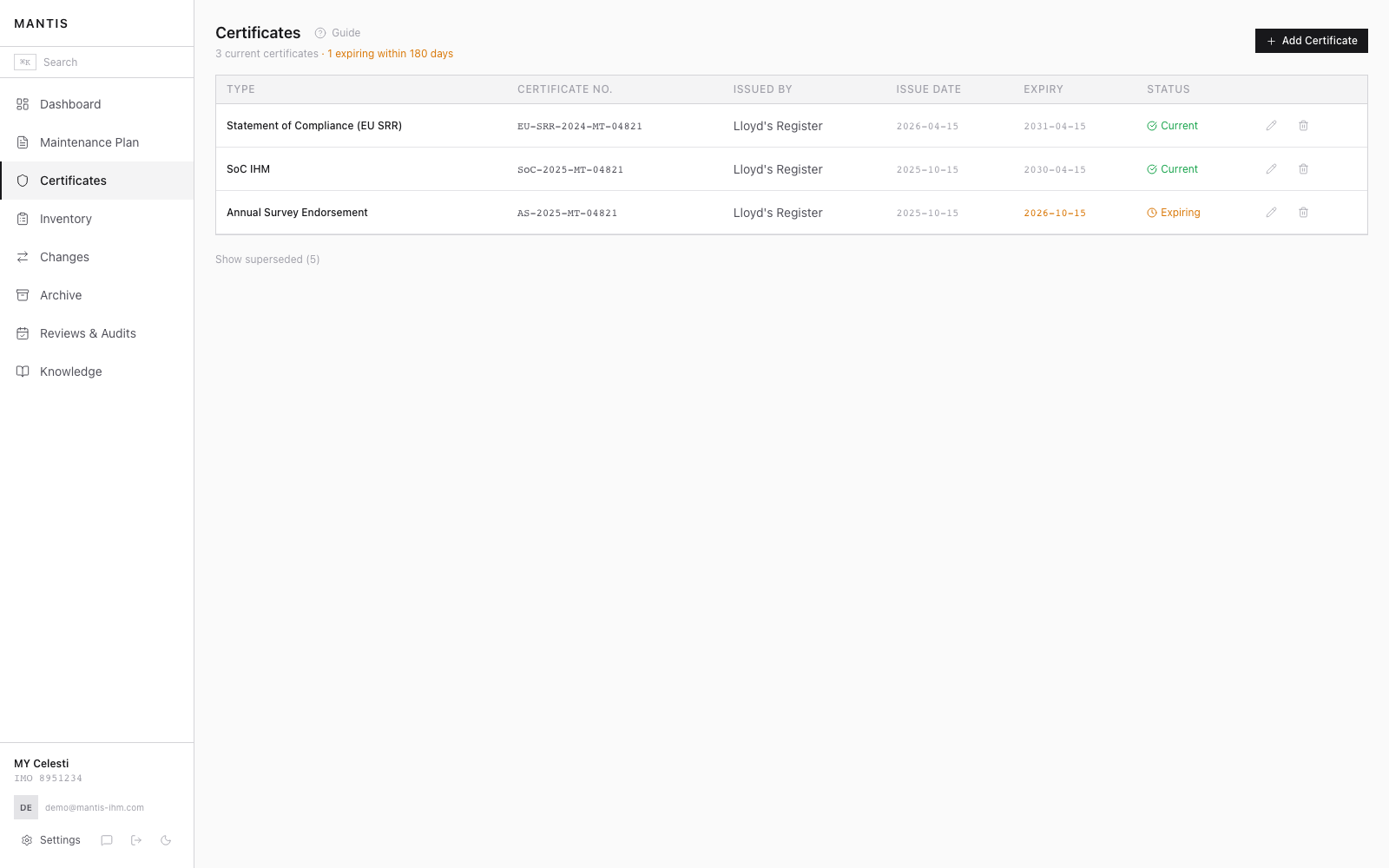
1. Verify your current ICIHM status
Confirm the current ICIHM is valid and determine exactly when it expires. If the certificate has already expired, contact your class society before proceeding — a lapsed ICIHM requires specific steps to reinstate.
Note the date range of the current certificate period. The renewal survey must be completed before expiry.
2. Review Part I against known changes
Work through Part I systematically. For each entry, ask: has anything changed since the last survey?
Changes that require a Part I update include:
- Equipment containing Annex I substances that was replaced or removed
- New equipment installed that contains Annex I substances
- Changes in the location or quantity of a listed material
- Changes in condition that are relevant to the entry
Changes that do not require a Part I update:
- Like-for-like replacement of equipment that contains no Annex I substances and is covered by a SDoC
If you identify changes that have not been recorded, record them now — with whatever supporting documentation you have — before the survey. Gaps identified during preparation are easier to address than gaps identified by the surveyor.
3. Locate all change records and supporting documentation
For every change recorded in Part I since the last survey, the supporting MD or SDoC should be on file. Verify that:
- Each change record has a corresponding MD or SDoC from the contractor or supplier
- The documentation matches the change entry — the material described, the date, and the location
- The documents are accessible and can be produced on request
If documentation is missing for a recorded change, refer to the current IMO IHM guidelines, including MEPC.379(80), on steps to take when supplier documentation is unavailable. Options include contacting the manufacturer directly or arranging sampling and analysis.
4. Check supporting SDS and stores records
Parts II and III are prepared before recycling, not maintained as the core operational certificate record. Still, SDS files and stores records are useful supporting documentation and should not be allowed to scatter.
Before the survey:
- Keep SDS files for hazardous stores current and accessible
- Remove superseded SDS files from the active set while retaining a clear history
- Make sure stores records do not conflict with Part I entries where a spare part has been installed
If a product has been reformulated, a new SDS reflecting the current formulation should replace the previous version in the active file.
5. Check operational waste records
Keep disposal receipts and MARPOL cross-references organised. They are not usually the centre of the IHM renewal survey, but they support later recycling preparation and wider environmental compliance.
6. Confirm the IHM is accessible and organised
The surveyor needs to be able to work through the IHM efficiently. Before the survey, confirm that:
- The IHM document (or digital record) is current — it reflects all updates made since the last survey
- Supporting documentation is organised and can be located quickly by section
- The location of the IHM on board is known and accessible
Common gaps found at renewal surveys
Based on the nature of the verification exercise, the areas most frequently in need of attention before a renewal survey are:
- Unrecorded refit changes — equipment was replaced during a yard period but the IHM was not updated and no MD/SDoC was collected from the contractor at the time
- Supporting SDS gaps — stores documentation has drifted, making later Part III preparation harder
- Missing MD/SDoC for recorded changes — the change log records the work, but the supporting documentation was not filed or has been lost
None of these are difficult to address during preparation — they become difficult when discovered by a surveyor after the survey has begun.
Timing
There is no regulatory minimum notice period before a renewal survey — the requirement is that the certificate does not lapse. In practice, scheduling the survey several weeks in advance allows time for any documentation gaps identified during preparation to be resolved.
Your class society or flag state administration will advise on scheduling and specific survey procedures for your registration.
Survey pack contents
| Include | Purpose |
|---|---|
| Current certificate and expiry date | Confirms validity and renewal timing. |
| Current IHM / Part I record | Shows the maintained inventory. |
| Change log since last survey | Shows maintenance history. |
| MD/SDoC/SDS evidence | Supports the relevant Part I entries. |
| Open issues and close-out notes | Shows known gaps are controlled. |
To understand what an inspector looks for, see IHM and Port State Control.
Related reading:
Prepare the renewal pack before the survey starts.
MANTIS tracks ICIHM expiry, organises Part I change records with linked MD/SDoC documentation, and generates survey-ready exports.
Request demo