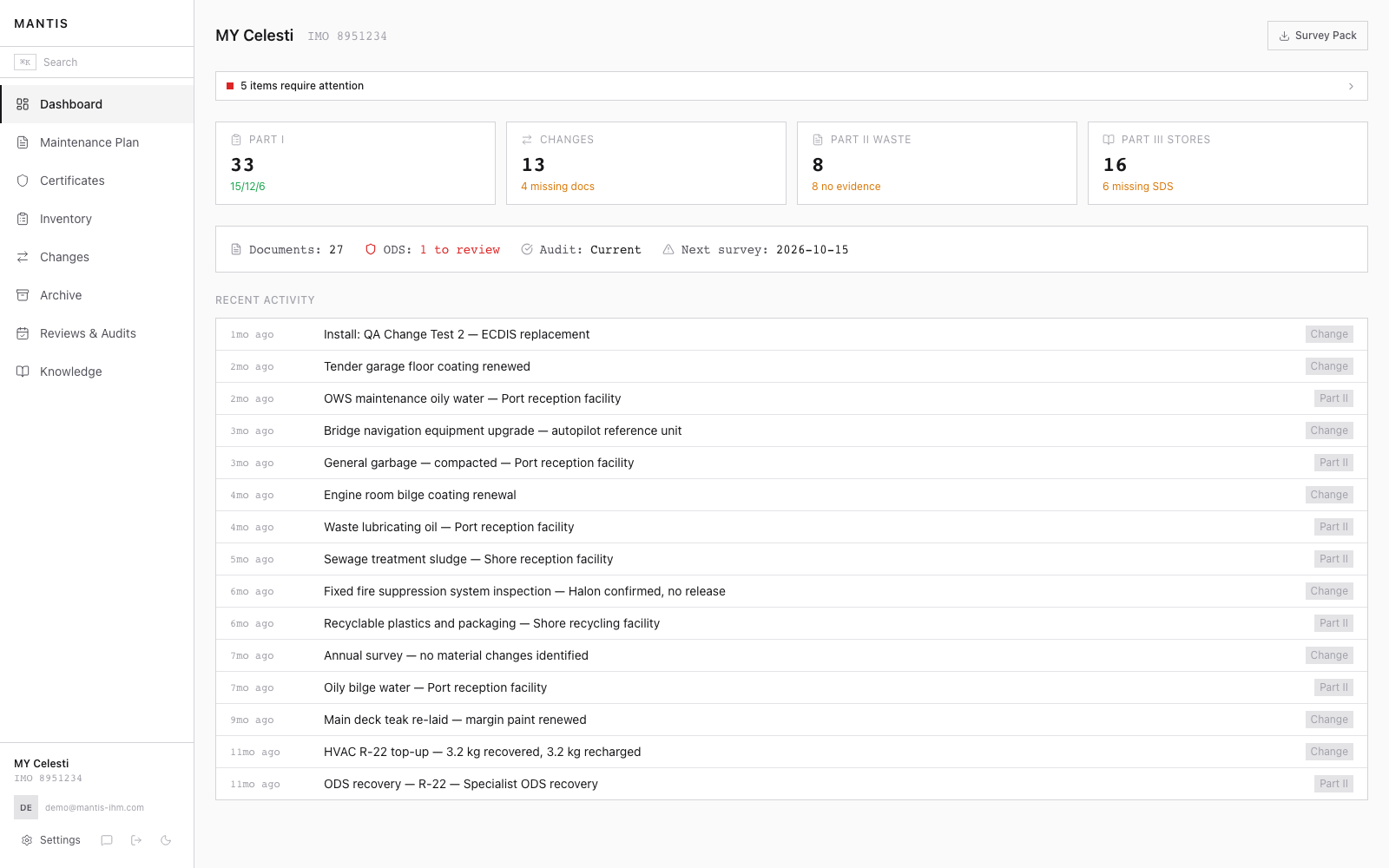
Once an IHM has been certified, the work is not finished. For an operating vessel, the main obligation is to keep Part I current throughout the vessel’s life.
That means the Inventory of Hazardous Materials should reflect the vessel as it is today, not as it was at the last survey. Equipment is replaced, coatings are renewed, insulation is disturbed, suppliers change, and parts are removed. Each relevant change needs a clear record and the evidence behind it.
This is the practical maintenance procedure every operator should have in place after certification.
Quick answer
After certification, IHM Part I maintenance is a repeatable loop: identify material changes, decide whether Part I is affected, collect MD/SDoC evidence, update the record where required, keep the revision history, and export the proof for survey or inspection.
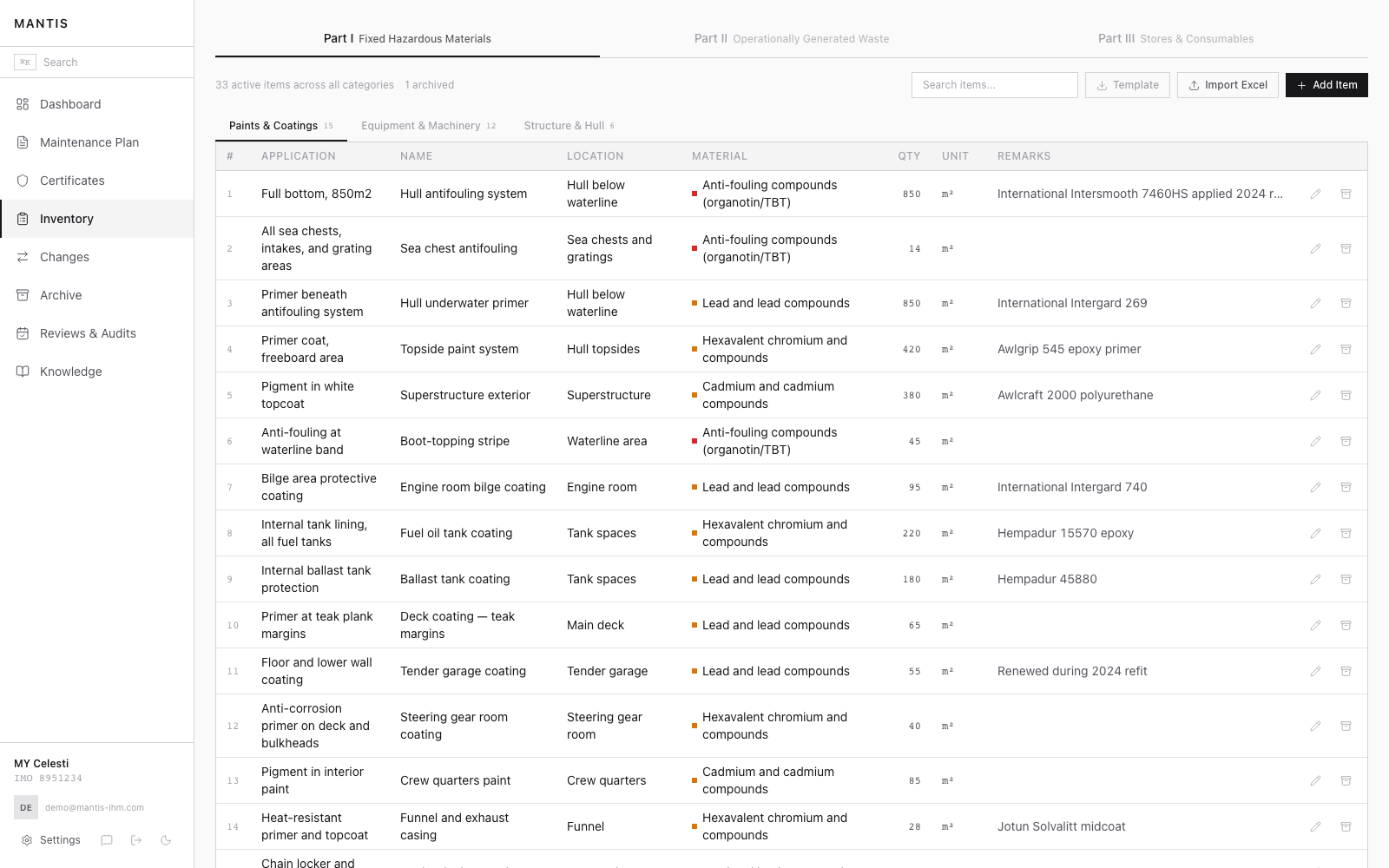
Log equipment, coating, insulation, refrigerant, or material changes while the work is still fresh.
Decide whether the change affects a controlled material, quantity, location, or status.
Request MD, SDoC, SDS, service reports, or sampling records before the supplier or yard closes the job.
Keep the file with the exact vessel item or change it supports, not in a loose email folder.
Revise Part I where required and preserve the reason when no inventory change is needed.
Keep the record ready for class, flag, PSC, management, sale, handover, or renewal survey review.
Start with the maintained Part I record
Part I covers hazardous materials contained in the vessel’s structure and equipment. It is the operational IHM record that needs to be kept current after certification.
Parts II and III are important, but they are prepared before recycling. During normal operation, SDS files, stores records, and waste records should stay organised because they support later recycling preparation and wider environmental compliance. They should not distract from the main maintenance loop: Part I plus evidence.
For the full structure, see IHM Part I, II and III explained.
Appoint a responsible person
The procedure needs an owner. Many operators call this the IHM Designated Person, but the exact title matters less than the responsibility.
That person should know:
- Where the current IHM is stored
- Which changes require review
- Who requests supplier evidence
- How updates are approved
- How records are prepared for class, flag, PSC, or management review
If nobody owns the process, Part I maintenance becomes a survey-time scramble. For the role itself, see The IHM Designated Person.
Track every material change event
The procedure should define the events that trigger an IHM check. At minimum, review Part I whenever there is:
- New equipment installed on board
- Equipment removed or replaced
- Hull coating work or relevant paint/coating change
- Insulation, gasket, seal, cable, flooring, or panel work involving controlled materials
- A refit, dry dock, yard period, or major repair
- A change in vessel particulars that affects certificate or inventory records
Not every change will create a new Part I entry. The point is to make sure the change is reviewed, not ignored.
For refits, the safest rule is simple: IHM evidence should be part of the work package before the job is closed. It is much harder to collect supplier declarations months later.
Decide whether Part I needs an update
The decision should happen at the change, not at survey.
If the vessel waits until renewal, the people, suppliers, and evidence may already be gone.
- 1Does the item, material, coating, or refrigerant fall inside IHM controlled-material scope?
- 2Does it change the location, approximate quantity, or status of a Part I material?
- 3Is there supplier, service, sampling, or declaration evidence to support the decision?
For each change, ask three questions:
- Does the item, material, or coating fall within the IHM controlled-material scope?
- Does it affect the location, approximate quantity, or status of a Part I material?
- Is there supplier documentation or sampling evidence to support the decision?
If the change introduces, removes, or alters a controlled material above the relevant threshold, Part I should be updated.
If the replacement is genuinely identical and the hazardous material position has not changed, the inventory may not need a new entry. Even then, keep the supporting supplier evidence with the maintenance record so the decision is defensible later.
Collect MD and SDoC evidence
Material Declarations and Supplier’s Declarations of Conformity are the evidence chain behind Part I. They show whether the supplied product contains controlled materials and whether it conforms to the declaration.
The best procedure is to request MD/SDoC at source:
- Include MD/SDoC requirements in purchase orders or contractor scopes
- Request the documents before installation where possible
- Store the declaration against the exact change it supports
- Keep the supplier name, product reference, date, and vessel location with the record
The ICS industry guidance notice is a useful reference for how shipowners and suppliers exchange MD/SDoC information.
For the practical workflow, see How to manage supplier MD/SDoC requests.
Keep a revision history
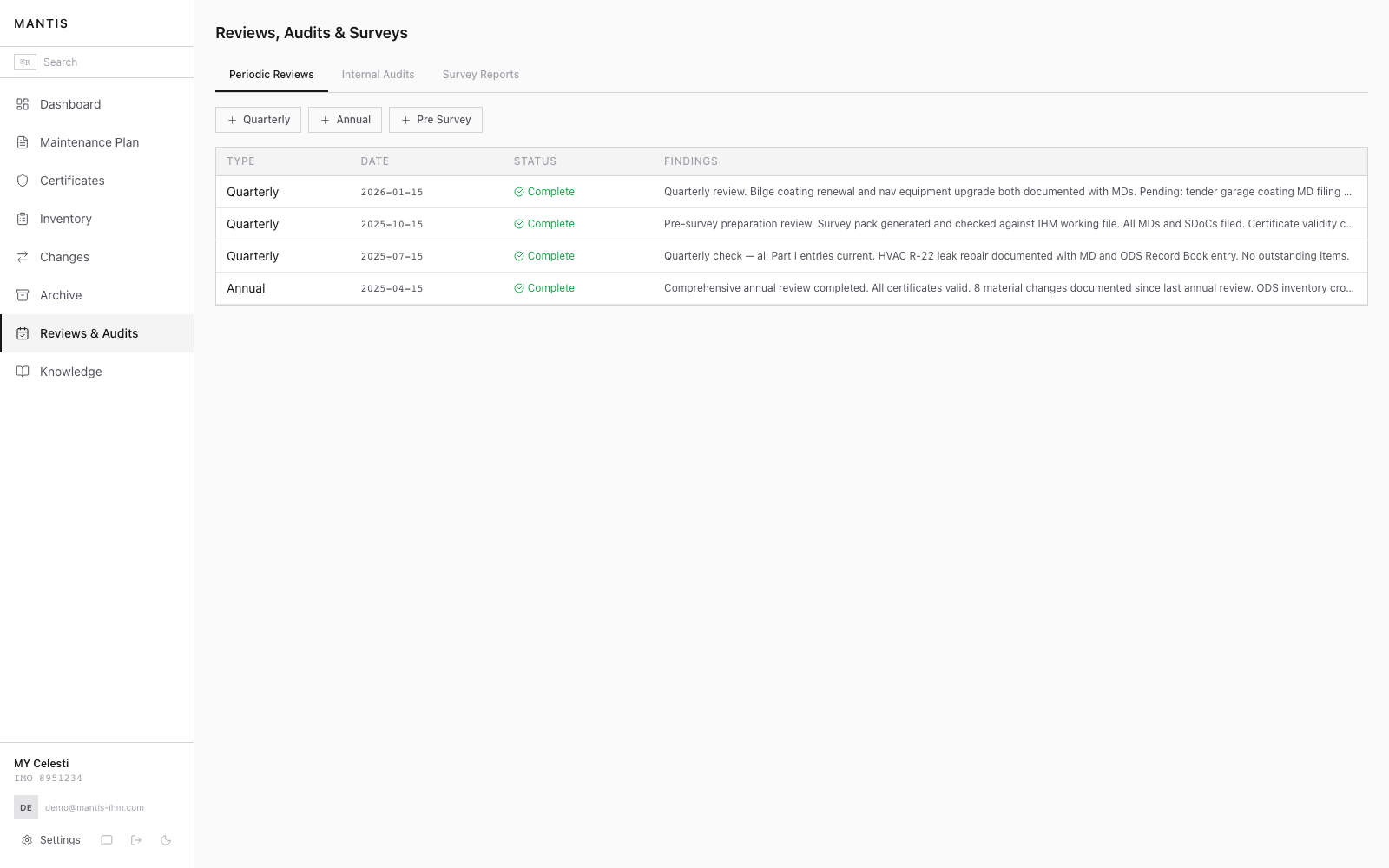
A maintained IHM needs a clear history. The latest Part I record matters, but reviewers also need to understand what changed.
Each update should capture:
- The date of the change
- The vessel area or equipment affected
- Whether the change was an addition, removal, replacement, or correction
- The linked MD/SDoC or other supporting evidence
- The person who made or approved the update
- Any notes explaining why no Part I update was required
This revision history is what turns the IHM from a static PDF into a maintained compliance record.
Set a review cadence
Do not wait for the renewal survey. The maintenance procedure should define how often the IHM owner reviews open changes, missing supplier evidence, and certificate dates.
A practical cadence is:
- Review new purchase/refit/change records regularly
- Chase missing MD/SDoC while the supplier relationship is still active
- Check certificate and survey dates monthly or quarterly
- Run a deeper internal review before class renewal, flag review, PSC exposure, sale, or management handover
The exact cadence should match the vessel and management system. The important point is that reviews are scheduled, not improvised.
Keep the current record accessible
An IHM that is technically maintained but impossible to locate is still operationally weak.
The current Part I record, certificate, maintenance procedure, change history, and supporting evidence should be accessible to the people who may need them:
- Master or responsible officer on board
- Chief Engineer or technical officer
- DPA or technical manager
- Fleet/compliance team
- Class or flag reviewer when invited
For survey and inspection purposes, the operator should be able to answer four questions quickly:
- What is currently listed in Part I?
- What changed since the last survey?
- Where is the MD/SDoC evidence?
- When is the next certificate or survey action due?
If the answer requires searching email, shared drives, and old exports, the procedure is not strong enough.
Prepare for renewal continuously
The renewal survey should verify an already-maintained record. It should not trigger a rebuild of the record from scratch.
Before renewal, the operator should already have:
- A current Part I record
- A valid certificate or clear renewal plan
- A revision history since the last survey
- Linked MD/SDoC evidence for relevant changes
- A documented maintenance procedure
- A clean export or evidence pack for the reviewer
For the survey checklist, see Before your IHM renewal survey. For inspection risk, see IHM and Port State Control.
What the reviewer should receive
A survey pack should make the maintained record easy to verify without forcing class, flag, PSC, or management to hunt through folders.
The latest vessel record with locations, materials, quantities, and status.
What changed since the last survey, who handled it, and why it matters.
MD, SDoC, SDS, service reports, or sampling evidence attached to the change.
Current certificate, renewal pressure, and any open review actions.
In short
IHM Part I maintenance is a loop:
- Record the change.
- Decide whether Part I is affected.
- Collect MD/SDoC evidence.
- Attach the evidence to the change.
- Update the inventory where required.
- Keep the revision history.
- Export the proof when someone asks.
That loop is the difference between having an old IHM file and maintaining a live IHM record.
Common procedure mistakes
- Treating the IHM as the PDF issued at the last survey.
- Reviewing changes only when a renewal survey is already booked.
- Recording a Part I update without attaching the supporting MD/SDoC evidence.
- Letting supplier evidence sit in procurement or yard email.
- Failing to record why a reviewed change did not require a Part I update.
Related reading:
Keep every Part I change tied to its evidence.
MANTIS keeps Part I changes, supplier MD/SDoC evidence, certificate dates, audit trail, and survey-ready exports in one workspace.
Request demo