
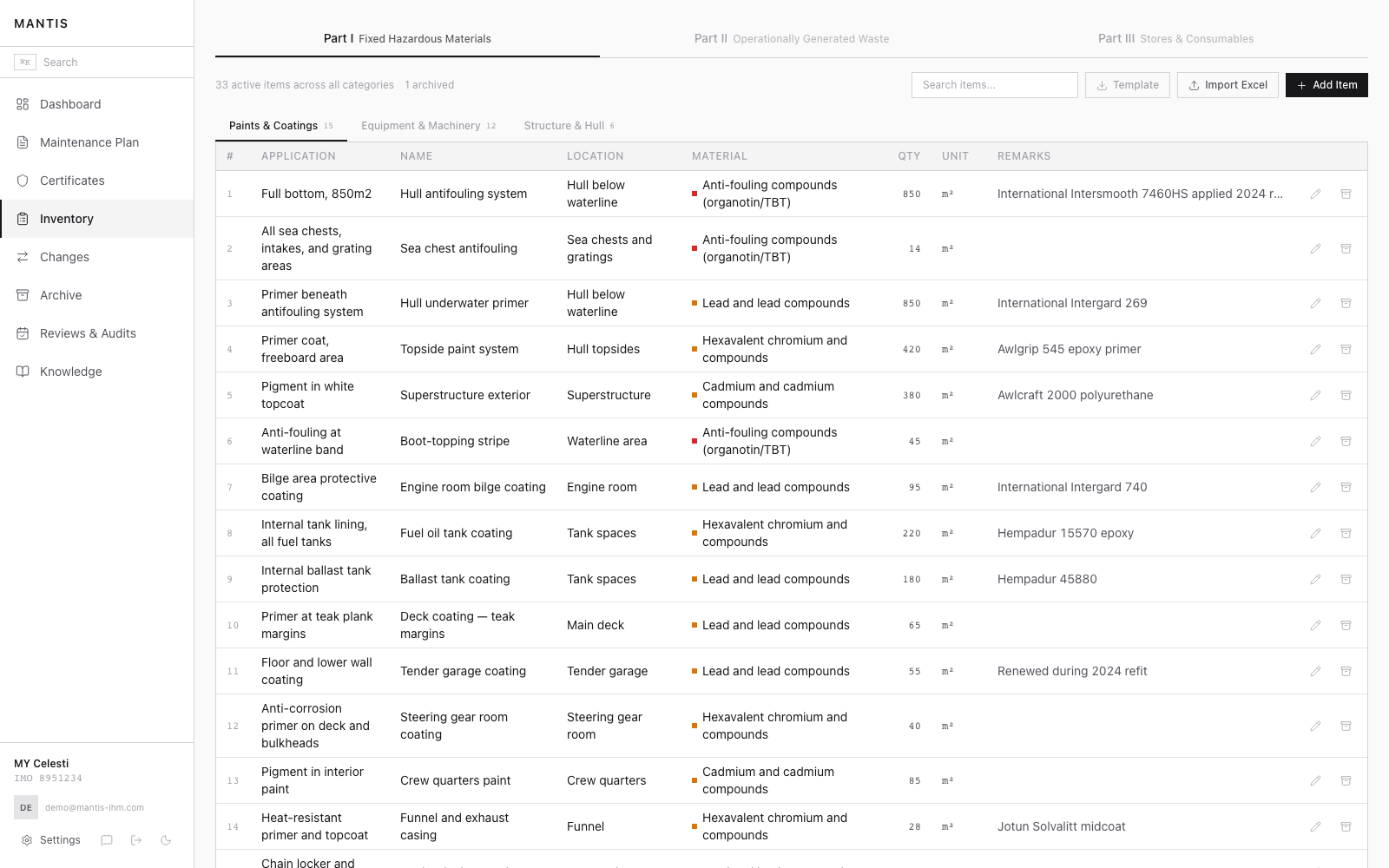
People talk about “the IHM” as if it were one document. It isn’t. The Inventory of Hazardous Materials has three parts, and they do not all behave the same way during a vessel’s operational life. The important distinction is simple: Part I is the maintained operational record; Parts II and III are completed when the vessel is being prepared for recycling.
Quick answer
Part I is the live operational record for hazardous materials in the vessel's structure and equipment. Parts II and III are mainly prepared before recycling, using waste and stores information available at that stage.
The quick version
| Part | Covers | Lives | Upkeep trigger |
|---|---|---|---|
| Part I | Hazardous materials built into the structure & equipment | Always — the core, certified document | Any material change (refit, replacement) |
| Part II | Operationally generated waste | Prepared before recycling | Final survey / recycling preparation |
| Part III | Stores on board | Prepared before recycling | Final survey / recycling preparation |
Part I is the one that must be kept genuinely current while the vessel is trading. Parts II and III matter, but they are not the normal day-to-day IHM maintenance burden.
Part I — hazardous materials in structure and equipment
This is the heart of the IHM: a material-by-material record of the hazardous substances that are built into the vessel — in the hull and structure, in machinery and equipment, in coatings, insulation, cabling, and gaskets.
The controlled substances come from the Convention’s annex tables — broadly, Table A materials (prohibited/restricted: asbestos, PCBs, certain ozone-depleting substances, organotin anti-foulings) and Table B materials (controlled above threshold: lead, mercury, cadmium, hexavalent chromium, and others). Part I records what is present, where, and in what quantity.
The defining feature of Part I is that it is a living document. It changes whenever a controlled material is added, removed, or changed — which in practice means at every refit and many equipment replacements. Each change should be logged when it happens and supported by Material Declarations and SDoC from the contractor. The renewal survey verifies that Part I has actually been maintained.
If you only get one part right, get Part I right.
Operational priority map
| During operation | Main action |
|---|---|
| Equipment installed or replaced | Review Part I impact and collect supplier evidence. |
| Refit or dry dock | Log material changes and attach MD/SDoC/SDS files. |
| Stores and chemicals change | Keep SDS and stores records organised for later Part III preparation. |
| Waste generated/disposed | Keep operational waste records organised for later Part II preparation. |
| Survey or inspection approaches | Export current Part I, certificate, change history, and evidence. |
Part II — operationally generated waste
Part II covers operationally generated waste present on board when the ship is being prepared for recycling. It is structured around waste categories and existing operational records rather than the Part I substance tables.
During ordinary trading, vessel teams still keep MARPOL records, disposal receipts, ODS records, and waste documentation for their own regimes. Those records can later support Part II preparation, but they are not the same thing as maintaining IHM Part I.
The practical habit is to keep operational waste records organised so the final Part II compilation is not a document hunt.
Part III — hazardous materials in stores
Part III covers stores on board when the ship is being prepared for recycling — paints, chemicals, spare products, and other materials that need to be known before the recycling facility plans the work.
During operation, keeping current SDS files is still good seamanship and supports later Part III preparation. But the maintained IHM certificate is built around Part I. If a spare part or product is installed into the vessel’s structure or equipment and contains a controlled material, that installation becomes a Part I change.
How the three fit together
The parts aren’t independent silos. Operational records, SDS files, and stores records can support Parts II and III later. Material changes during service update Part I now. The value of keeping them in one workspace is that the evidence stays connected instead of scattering across folders, record books, and inboxes.
That’s the whole case for managing the IHM as one connected workspace rather than three disconnected documents — which is what MANTIS is built to do.
For the operational process, see maintaining IHM Part I.
Common Part I/II/III mistakes
- Spending equal daily effort on all three parts when Part I is the operational maintenance burden.
- Forgetting that SDS and stores records can support future Part III preparation.
- Recording a Part I change without the supplier evidence behind it.
- Treating Parts II and III as irrelevant until the final survey, then discovering records have scattered.
Related reading:
---Keep Part I live while supporting Parts II and III later.
MANTIS is IHM compliance software. It keeps the maintained Part I record, supplier evidence, certificates, audit trail, and recycling-ready supporting records in one workspace.
Request demo