The Hong Kong Convention uses an International Certificate on Inventory of Hazardous Materials (ICIHM). The EU Ship Recycling Regulation uses an Inventory Certificate for EU-flagged ships and a Statement of Compliance for third-country ships calling at EU ports or anchorages. Since January 2026, an updated EU Inventory Certificate format can also be used under the Hong Kong Convention, reducing duplicate certification for EU-flagged ships where both regimes apply.
That does not mean every ship now carries the same document. The correct route still depends on flag, operating pattern, the applicable regime and the authority issuing or endorsing the document.
Quick answer
Maintain one accurate Part I record. For an EU-flagged ship, the 2026 EU Inventory Certificate format can be used under both the EU SRR and HKC where both apply. A third-country ship calling at an EU port or anchorage remains on the EU Statement of Compliance route. Confirm the vessel-specific document with the flag administration or its authorised recognised organisation.
Start with the inventory, not the certificate
Both regimes rely on a ship-specific Inventory of Hazardous Materials. During operation, the maintained record is Part I: relevant hazardous materials in the ship’s structure and equipment. Parts II and III are completed when the ship is prepared for recycling. The current IMO technical reference is MEPC.379(80), as amended by MEPC.405(83).
The inventory and the certificate are not the same thing. Part I is the maintained ship record; the certificate or Statement of Compliance records that the applicable verification and survey route has been completed.
The EU SRR route — the older of the two
The EU Ship Recycling Regulation applies to ships flying an EU Member State flag and, through Article 12, to third-country ships calling at an EU port or anchorage. It excludes warships and government non-commercial ships, ships below 500 GT, and ships operating throughout their life only in waters under the jurisdiction of their flag State.
Under the EU SRR, an in-scope vessel carries:
- A maintained Part I of the Inventory of Hazardous Materials during operation; and
- An Inventory Certificate for an EU-flagged ship, or a Statement of Compliance for an in-scope third-country ship calling at an EU port or anchorage.
The Statement of Compliance is issued after verification by the relevant authority of the third country whose flag the ship flies, or by an organisation that authority authorises. The 2026 EU Inventory Certificate format change does not remove this Article 12 route.
The HKC route — now global
The Hong Kong Convention entered into force on 26 June 2025. It applies to ships entitled to fly the flag of a Party, subject to its scope and exclusions. Ships of non-Parties may face equivalent inspection requirements in Party ports under the no-more-favourable-treatment principle.
For a ship within the certification provisions, the HKC document is the International Certificate on Inventory of Hazardous Materials (ICIHM). It is issued by the flag administration or a person or organisation it authorises after successful survey.
We cover what the Convention coming into force changed in our HKC briefing.
What changed in January 2026?
Commission Implementing Decision (EU) 2026/121 replaced the format of the EU Inventory Certificate. The Commission states that the updated format enables shipowners to meet EU SRR and Hong Kong Convention obligations with a single certificate where both apply.
This is a format and administrative-alignment measure. It does not merge the two legal regimes, reduce EU requirements, or replace the Statement of Compliance required by Article 12 for an in-scope third-country ship.
So do you need more than one document?
It depends on the ship:
- EU-flagged ship where both regimes apply: the updated EU Inventory Certificate format can serve under both the EU SRR and HKC, subject to issue by the competent administration or recognised organisation.
- Third-country ship calling at an EU port or anchorage: Article 12 of the EU SRR still requires a Statement of Compliance. If the ship also falls under the HKC through its flag, confirm with the flag administration or authorised recognised organisation how the HKC and EU documents will be handled.
- Ship flying the flag of an HKC Party outside the EU route: the HKC certification document is the ICIHM.
- Ship flying a non-Party flag: it cannot be issued an HKC certificate, but equivalent documentation may be expected in Party ports under no-more-favourable treatment.
In every case, the certification route should use one controlled Part I rather than competing inventory files.
Certificate decision table
| Vessel position | Likely document route to confirm |
|---|---|
| EU-flagged ship within EU SRR scope | EU Inventory Certificate; the 2026 format can also serve under HKC where applicable. |
| Third-country ship within Article 12 scope | EU SRR Statement of Compliance from the relevant third-country authority or its authorised organisation. |
| Ship within HKC certification provisions | ICIHM through the flag administration or its authorised organisation. |
| Ship potentially within both regimes | One maintained Part I supports the applicable route; confirm the document with the responsible authority. |
What this means for how you keep records
The operational priority is the same under either regime: keep Part I current, retain supporting documentation, and track the applicable certificate and survey dates. A relevant change during a refit is assessed once and recorded in the controlled Part I where required.
Do not create a second inventory simply because another certification regime becomes relevant. Ask the responsible authority how the existing verified inventory and certificate format will be recognised or reissued.
If you are still working out whether your vessel is in scope of one regime, both, or neither, confirm the position with the flag administration or its authorised recognised organisation.
Common certificate mistakes
- Maintaining competing Part I files for HKC and EU SRR.
- Treating the certificate as the record instead of the output of the record.
- Forgetting that Part I maintenance continues after certification.
- Assuming the 2026 combined format applies to third-country Statements of Compliance.
- Assuming every ship of 500 GT and above has the same scope or certificate route.
- Referring only to “class” without confirming that the organisation is authorised for the relevant flag and regime.
- Assuming EU port-call requirements disappear because a ship is not EU-flagged.
Related reading:
---Keep one controlled Part I ready for the applicable certificate.
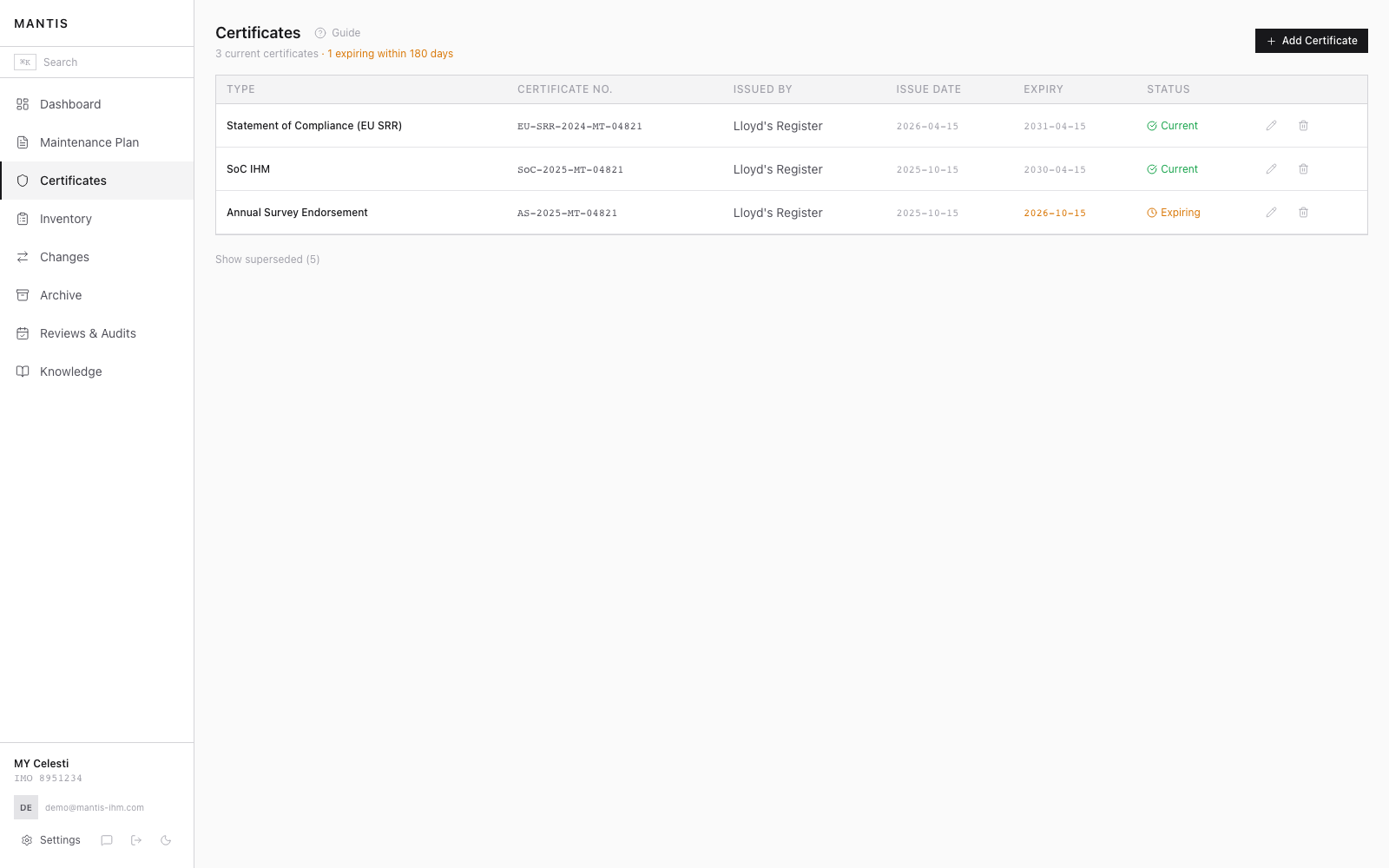
MANTIS is IHM compliance software. It keeps Part I and supporting documentation current, tracks certificate expiry and survey dates, and generates exports for review by the relevant authority or authorised organisation.
Request demo