It is the first question, and it is genuinely harder to answer than it should be: does my vessel actually need an Inventory of Hazardous Materials? The broad regulatory pages can be hard to turn into an operational answer. Here is the practical version.
Quick answer
If the vessel is 500 GT or above, treat IHM scope as a question to resolve promptly. Flag, operating area, ship use, EU port calls and the specific exclusions determine which regime and certification route apply. Confirm the position with the flag administration or an organisation it has authorised.
The headline thresholds
Two instruments set the scope, and they are scoped differently:
- The Hong Kong Convention (HKC), in force since 26 June 2025, applies to ships of 500 GT and above entitled to fly the flag of a Party and operating on international voyages, subject to the Convention’s exclusions. Ships flying the flag of a non-Party may face equivalent treatment in a Party’s ports under the Convention’s no-more-favourable-treatment provision.
- The EU Ship Recycling Regulation (EU SRR, Regulation 1257/2013) applies to EU-flagged ships within its scope and, through Article 12, sets IHM requirements for third-country ships calling at EU ports or anchorages. Its exclusions include warships, government non-commercial ships and ships below 500 GT.
So the first filter is simple: 500 gross tonnage. Below it, neither regime brings the IHM obligation in the same way (though your flag State may have its own requirements — always worth checking).
Scope checklist
| Check | What to verify |
|---|---|
| Gross tonnage | Use the International Tonnage Certificate, not vessel length. |
| Voyage pattern | Confirm whether the vessel is on international voyages. |
| Flag | Check whether EU SRR or HKC certification pathways apply. |
| EU port calls | Non-EU vessels can still fall under EU SRR if they call at EU ports. |
| Survey cycle | Check when the next renewal survey or certificate action falls. |
Why gross tonnage is not length
Here is the trap. Gross tonnage is a measure of enclosed volume, not length, and the relationship between the two is not linear. Similar-looking vessels can sit on different sides of 500 GT. You cannot read your scope off length alone.
The number that matters is on your International Tonnage Certificate. If you are near the threshold, that certificate is the authority — not a rule of thumb about metres.
The EU port-call trigger
Even if your vessel is not EU-flagged, Article 12 of the EU SRR can still apply. An in-scope third-country ship that calls at an EU port or anchorage carries an Inventory of Hazardous Materials and a Statement of Compliance issued or endorsed by the relevant third-country authority or an organisation it authorises.
This is why many non-EU-flagged vessels that trade into EU ports were already planning for IHM before the HKC entered into force. The applicable certification routes can rely on one maintained Part I; we explain the 2026 EU certificate alignment in HKC and EU SRR IHM certificates: what applies in 2026?.
Registration and trade pattern
A common question is whether registration category changes the answer. The IHM obligation flows primarily from gross tonnage, flag, and where the vessel trades, rather than from registration wording alone. But registration category can affect how the requirement is applied and which survey regime your flag administers. This is exactly the kind of detail to confirm with your flag State or class society rather than assume either way.
We deliberately do not give a blanket yes/no here, because the honest answer is it depends on your specific registration and trading pattern — and getting that wrong in either direction is costly.
Common scope mistakes
- Using length as a shortcut for gross tonnage.
- Assuming a non-EU flag avoids EU SRR even when the vessel calls at EU ports.
- Assuming an older vessel is exempt because it predates the rules.
- Treating a checker result as final instead of confirming with flag or class.
- Waiting until a port call or renewal survey to ask the scope question.
Build year is not a blanket exemption
An older vessel is not automatically exempt because it predates the rules. What changes for older vessels is how the initial inventory is built when the original builder’s records are incomplete — through document review plus a visual and sampling check by a competent person. We cover that pathway in IHM on older vessels.
And if the answer is “yes, in scope,” the next question is how to keep Part I current as the vessel changes. See our guide to maintaining IHM Part I.
Related reading:
Track scope, certificates, and survey pressure in one place.
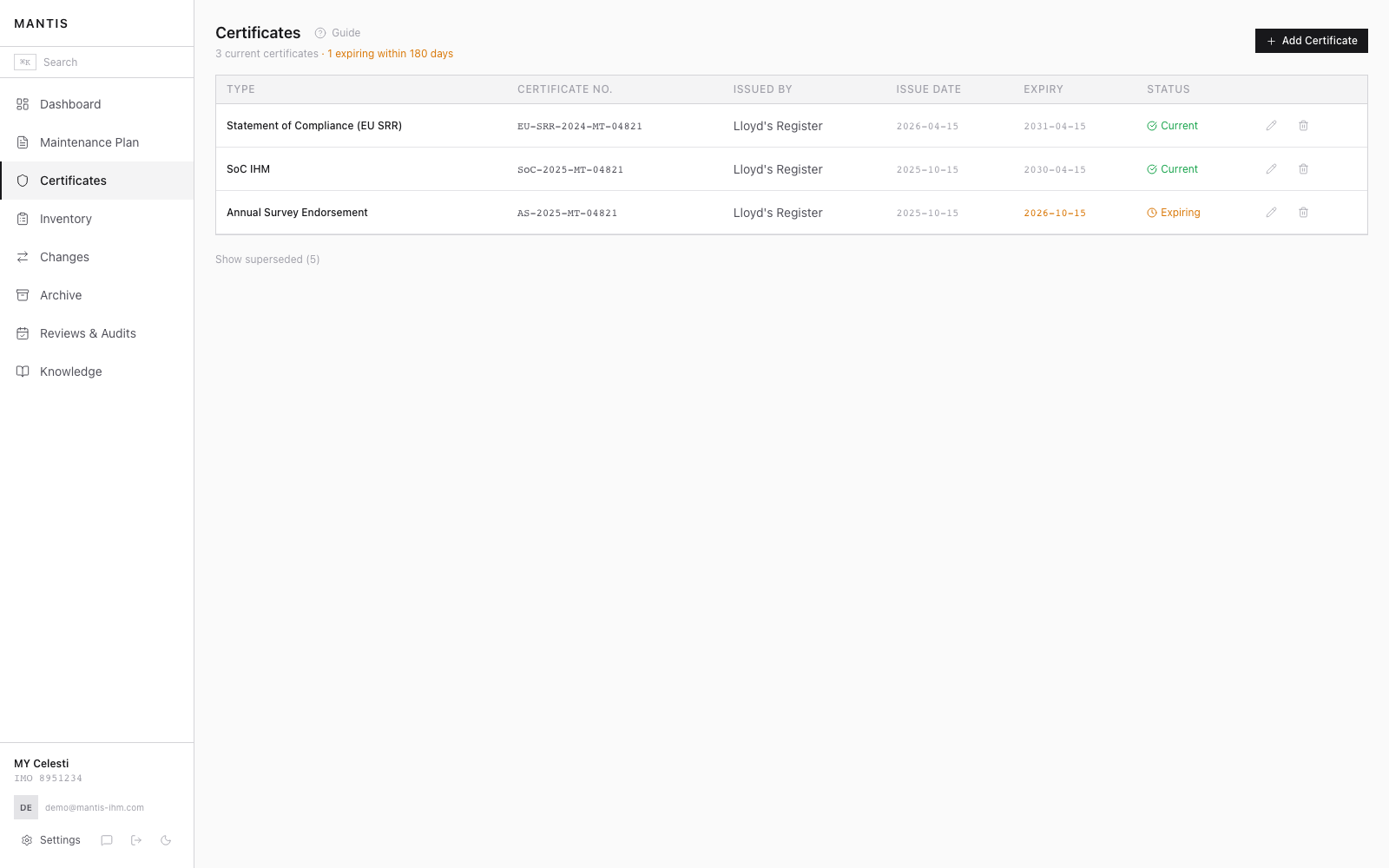
MANTIS is IHM compliance software. It maintains Part I records, prepares Parts II and III for recycling, tracks certificate expiry and survey intervals, and generates survey-ready exports for class society review.
Request demo