
For sixteen years, the Hong Kong International Convention for the Safe and Environmentally Sound Recycling of Ships had not met the conditions for entry into force. That changed on 26 June 2025, when the Convention entered into force. It created an international IHM regime alongside the EU Ship Recycling Regulation.
If your vessel is 500 GT or above, here is what that shift means in practice.
Quick answer
For an internationally trading ship of 500 GT or above, the vessel's flag, the ports it calls at, and the applicable exclusions determine the certification route. Where the HKC applies, the practical work is not only obtaining the ICIHM; it is keeping Part I current and retaining the evidence needed for survey or inspection.
What actually changed on 26 June 2025
The HKC applies to ships entitled to fly the flag of a Party, subject to its scope and exclusions. It excludes, among other categories, ships of less than 500 GT and ships operating throughout their life only in waters under the sovereignty or jurisdiction of their flag State. A Party must nevertheless apply measures so that excluded domestic ships act consistently with the Convention so far as reasonable and practicable. Ships flying the flag of a non-Party may face equivalent treatment in a Party’s ports under the Convention’s no-more-favourable-treatment provision.
EU-flagged ships are also subject to the EU Ship Recycling Regulation (EU SRR, Regulation 1257/2013). Non-EU ships calling at an EU port or anchorage fall under the separate Article 12 route, including an IHM and Statement of Compliance, subject to the Regulation’s scope and exclusions.
Where the HKC certification provisions apply, the operational certificate is the International Certificate on Inventory of Hazardous Materials (ICIHM). It is issued by the flag administration or a person or organisation it authorises after a successful survey.
At the end of a ship’s life, the HKC uses an International Ready for Recycling Certificate and requires a ship-specific Ship Recycling Plan. These are distinct from the operational ICIHM and from the EU Article 12 Statement of Compliance carried by qualifying third-country ships calling at EU ports.
What a compliant IHM looks like
An IHM under the HKC has three parts, but they are not maintained in the same way during the vessel’s operating life:
Part I — Hazardous materials in the vessel structure and equipment. This is the operational core of the IHM. For a new ship, it is developed from design, construction and supply-chain information. For an existing ship, the IMO Guidelines set out document assessment followed by a visual or sampling check plan and onboard checks. The flag administration or its authorised organisation verifies Part I through the applicable survey.
Crucially, Part I is not a one-time survey. It must be maintained throughout the ship’s operational life, reflecting relevant new installations and changes in structure and equipment. The IMO Guidelines describe the update process and provide an exception when identical parts or coatings are installed or applied.
Part II — Operationally generated waste. Prepared before recycling, using the operational waste records and quantities present on board at that stage.
Part III — Stores. Prepared before recycling, using the stores and supporting documentation present on board at that stage.
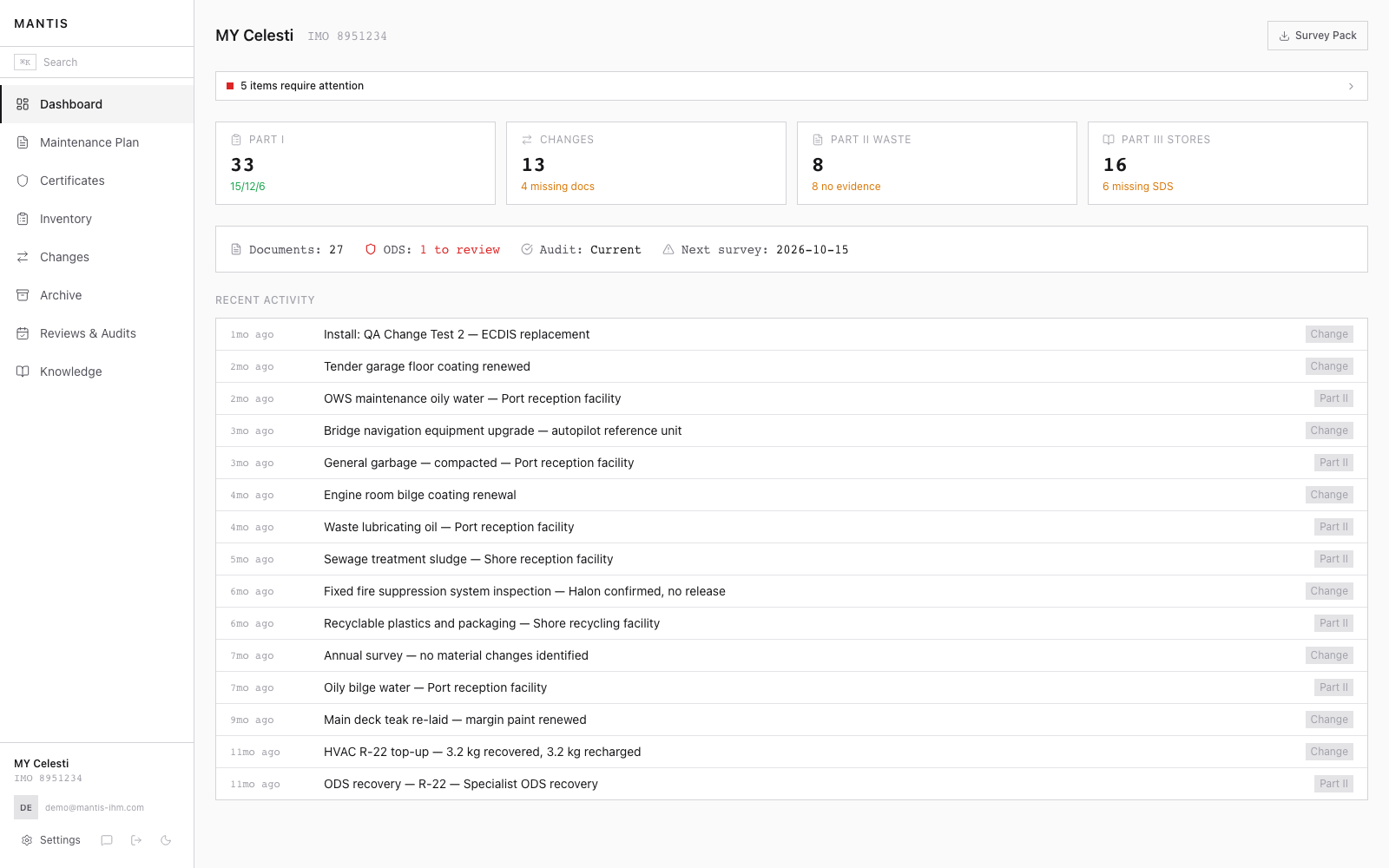
For an operating vessel, the maintenance discipline is centred on Part I: recording material changes and keeping the evidence behind those changes.
Operational evidence map
| Evidence | Why it matters |
|---|---|
| Current IHM / Part I record | Shows what controlled materials are recorded onboard. |
| ICIHM or applicable certificate | Shows the inventory has been verified through the certification pathway. |
| Change records | Shows what changed since the last survey. |
| MD/SDoC/SDS evidence | Supports supplier and material declarations behind Part I decisions. |
| Audit trail | Shows who updated or reviewed the record and when. |
The survey cycle you need to track
The ICIHM follows a survey cycle defined in the Convention:
- Initial survey — before the ICIHM is issued, confirming the IHM is complete, accurate, and properly documented
- Renewal survey — at intervals specified by the administration but not exceeding five years
Write down the dates now. Resolve certificate-expiry pressure and any open change records before the next survey or inspection.
Your class society or flag state administration can advise on whether additional survey requirements apply under your specific registration.
PSC enforcement — what you need to be ready for
Port State Control authorities in HKC Parties may inspect a foreign ship to verify that it holds a valid certificate. A more detailed inspection may follow where there are clear grounds to believe that the ship or its equipment does not correspond substantially with the certificate or required IHM controls.
Depending on the inspection or survey context, the vessel team should be able to produce:
- The current ICIHM and its validity dates
- The IHM itself — particularly that Part I is populated, not blank
- Change records for the period since the last survey
- Available Material Declarations and Supplier’s Declarations of Conformity supporting relevant equipment and material decisions
- Evidence that the IHM has been maintained since the last survey, especially supplier declarations behind Part I changes
Potential gaps to address before survey or inspection include:
- ICIHM expired — missed renewal survey
- No change records for a known refit — equipment was replaced but the IHM was not updated
- Missing MD/SDoC documentation — a material change was made but contractor documentation was not collected
- Evidence gap — the Part I entry exists, but the declaration or supporting document behind it cannot be produced
For the applicable consequences and enforcement procedures, refer to your flag state administration or the relevant MOU (Paris, Tokyo, Indian Ocean, etc.) guidelines.
Common HKC mistakes
- Treating the ICIHM as a one-time certificate rather than a maintained record.
- Updating equipment onboard without recording the Part I impact.
- Keeping MD/SDoC evidence outside the vessel’s IHM workspace.
- Missing renewal pressure because certificate dates are tracked separately.
- Assuming EU SRR experience removes the need to confirm the HKC certificate route with flag or class.
Flag state considerations
For vessel teams:
- EU-flagged vessels: The EU SRR applies. Since the 2026 format update, the EU Inventory Certificate can be used under both the EU SRR and HKC where both regimes apply, provided it is issued in the prescribed form.
- Non-EU flags: Check whether the flag State is an HKC Party and what certification pathway its administration requires. A qualifying third-country ship calling at an EU port or anchorage also needs the Article 12 EU SRR documentation route.
If you are unsure which certification pathway applies, contact the flag administration or an organisation it has authorised for that work.
A checklist for your next port call
Four things worth verifying before your vessel arrives at a HKC-signatory port:
- ICIHM validity — is the certificate current, and is the next renewal date in your calendar?
- Change records — is there any equipment replacement or refit work since the last verified revision that has not been assessed under the IHM maintenance procedure?
- MD/SDoC file — do you have the relevant Material Declarations and Supplier’s Declarations of Conformity from the supply chain?
- Evidence access — can you produce the MD/SDoC or supporting document behind each Part I change?
These are document-readiness checks, not a substitute for any survey the applicable authority requires.
The practical reality
The HKC is not an entirely new operational discipline for vessels that have already been maintaining an IHM under the EU regime. Its entry into force extended the international treaty framework beyond the EU system. For vessels that have treated the IHM as a one-time survey box-tick — typically drafted at delivery and never touched since — that approach does not meet the maintenance obligation.
The IHM is a controlled, maintained record. New installations and relevant changes must pass through the ship’s IHM maintenance process, supported by the applicable supply-chain declarations. The certificate records successful verification under the relevant survey regime; it does not replace the underlying Part I or its evidence.
For how the HKC certificate relates to the EU regime, see HKC and EU SRR IHM certificates: what applies in 2026?.
Related reading:
---Turn HKC requirements into a maintained vessel workflow.
MANTIS is IHM compliance software. It keeps the maintained Part I record, MD/SDoC evidence, certificates, audit trail, and survey-ready exports in one workspace.
Request demo