The Hong Kong Convention entered into force on 26 June 2025. Existing ships within its scope must comply with the Inventory of Hazardous Materials requirements no later than 26 June 2030, or before going for recycling if that happens earlier. For a ship remaining in operation, successful completion of the required initial survey leads to an International Certificate on Inventory of Hazardous Materials (ICIHM).
The important distinction is this: IMO guidance says the initial IHM survey for an existing ship should be harmonised with renewal surveys under other applicable statutory instruments. That helps administrations and operators coordinate survey work, but it does not make the first statutory renewal survey after 26 June 2025 a universal ICIHM deadline.
Quick answer
For an existing ship within scope, the Hong Kong Convention requires compliance no later than 26 June 2030. Agree the initial-survey timing with the flag administration or its authorised recognised organisation; it may be coordinated with another statutory renewal survey.
What about new ships?
New ships within the Convention’s scope do not have the existing-ship transition period. The IMO’s implementation FAQ confirms that, from 26 June 2025, new ships must have an ICIHM. Part I of the IHM is prepared during design and construction, then verified by an initial survey before the ship is put into service.
The Convention uses defined construction-contract, keel-laying or equivalent-stage, and delivery criteria to distinguish a “new ship” from an “existing ship.” A project described commercially as a new build should therefore have its formal status confirmed by the flag administration or its authorised recognised organisation.
For the owner and shipyard, the practical priority is to establish the IHM baseline during the build: collect Material Declarations and Supplier’s Declarations of Conformity from the yard and equipment suppliers, identify relevant hazardous materials in the structure and equipment, and preserve that evidence for the initial survey. Reconstructing the baseline after delivery is much harder.
What the Convention and survey guidance say
For an existing ship, three points matter:
- The outside compliance date is 26 June 2030. Regulation 5 gives existing ships no more than five years from the Convention’s entry into force to comply, unless the ship goes for recycling earlier.
- An initial survey comes before the ICIHM is issued. The IMO’s survey and certification guidelines say this initial survey must occur no later than five years after entry into force.
- Survey harmonisation is a scheduling principle. The same guidelines say the initial survey should be harmonised with renewal surveys required by other applicable IMO instruments. They do not create a blanket first-renewal deadline.
After the ICIHM has been issued, its own renewal survey cycle applies at intervals set by the administration and not exceeding five years.
The Hong Kong Convention generally concerns commercial ships of 500 GT and above operating internationally, but its scope includes exclusions and is implemented through flag and port States. Confirm the position for the specific ship rather than relying on tonnage alone.
This also sits alongside the EU Ship Recycling Regulation. Its onboard IHM requirements have applied since 31 December 2020 to existing EU-flagged ships and to non-EU ships calling at an EU port or anchorage, subject to the Regulation’s scope. A ship trading in Europe may therefore already have an IHM and an EU certificate or Statement of Compliance. See how the two regimes relate.
Confirm scope, the certification route, and the agreed survey date with the ship’s flag State administration or its authorised recognised organisation. This article is general guidance, not a determination for a particular ship.
Why waiting until 2030 is still a poor plan
Although 26 June 2030 is the outside date for existing in-scope ships, it should be treated as the finish line rather than the date to begin. Starting earlier matters because:
- Building the initial inventory takes time. This is especially true for older vessels where builder records are incomplete. Development may involve document review and a visual or sampling check before the initial survey can be completed.
- Survey capacity and evidence gaps need lead time. The operator, flag administration or recognised organisation, and any IHM specialist need an agreed plan before the deadline.
- EU obligations may already apply. A ship within the EU SRR scope should not use the HKC transition period as a reason to postpone an obligation already in force.
- Part I must remain current. Certification is not the finish — Part I is maintained as relevant changes occur throughout the ship’s operational life.
The earlier the inventory and evidence are reviewed, the more time there is to resolve missing records without turning compliance into a deadline exercise.
Deadline planning checklist
| Step | Action |
|---|---|
| Confirm scope | Check 500 GT, international voyage pattern, flag, and EU port calls. |
| Agree the certification route | Ask the flag administration or authorised recognised organisation what certificate and process apply. |
| Agree the initial-survey date | Confirm whether the survey will be coordinated with another statutory renewal survey and leave time before 26 June 2030. |
| Confirm current inventory status | Identify whether the vessel already has a usable IHM. |
| Build missing evidence | Gather builder records, supplier evidence, and survey inputs early. |
| Start maintenance process | Assign responsibility and keep Part I current immediately after certification. |
What to do now
A sensible sequence, regardless of where your vessel sits:
- Confirm scope. Check gross tonnage, ship type, flag, operating area, and EU port calls. The flag administration or recognised organisation should confirm the result.
- Check what already exists. An IHM or EU certificate may already cover much of the underlying work, but the applicable authority should confirm what is accepted for HKC certification.
- Agree the initial-survey plan. Decide with the flag administration or recognised organisation when the survey will occur and whether it will be harmonised with another statutory renewal.
- Resolve inventory and evidence gaps. If the ship does not have a verified, current Part I, begin the development or update process early.
- Maintain the record after certification. Assign responsibility and capture material changes and MD/SDoC documentation as work happens.
- Track the certificate cycle. Once issued, record ICIHM validity and its own renewal-survey date.
None of this is dramatic. It’s a scheduling-and-records exercise that rewards starting early and punishes leaving it to the last survey.
Common deadline mistakes
- Treating 26 June 2030 as the date to start work rather than the final compliance date.
- Mistaking survey-harmonisation guidance for a universal first-renewal deadline.
- Assuming that 500 GT alone determines scope.
- Ignoring EU SRR obligations that may already apply.
- Booking the initial IHM work too late for older vessels with missing records.
- Treating the inventory and the certificate as the same thing.
- Getting certified but not maintaining Part I afterward.
- Tracking the date in one person’s calendar instead of the vessel record.
For the operational process after certification, see maintaining IHM Part I.
Related reading:
Make ICIHM dates visible before they become urgent.
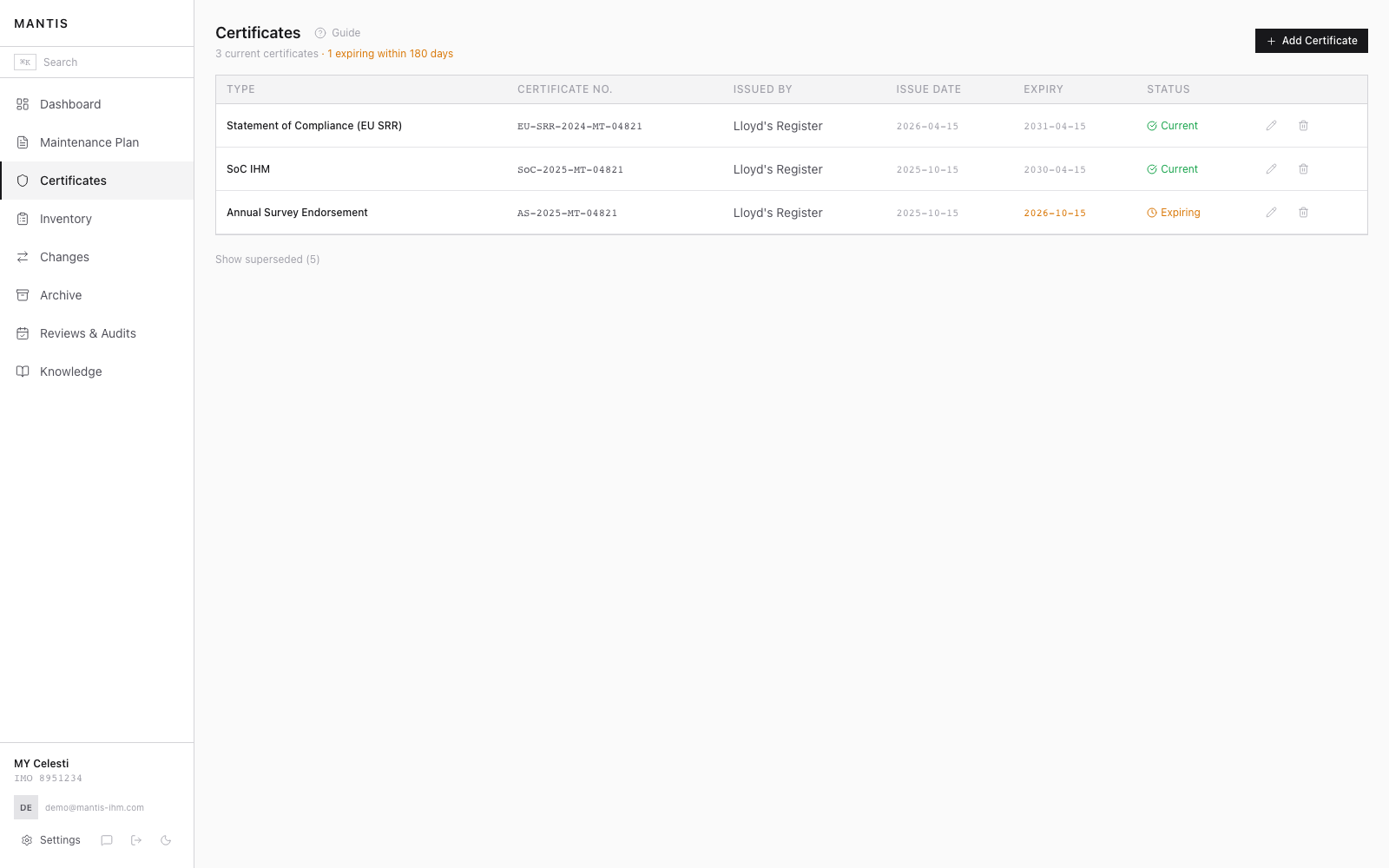
MANTIS is IHM compliance software. It tracks certificate expiry and agreed survey dates, manages Part I records and MD/SDoC documentation, and generates survey-ready exports for class or flag review.
Request demo