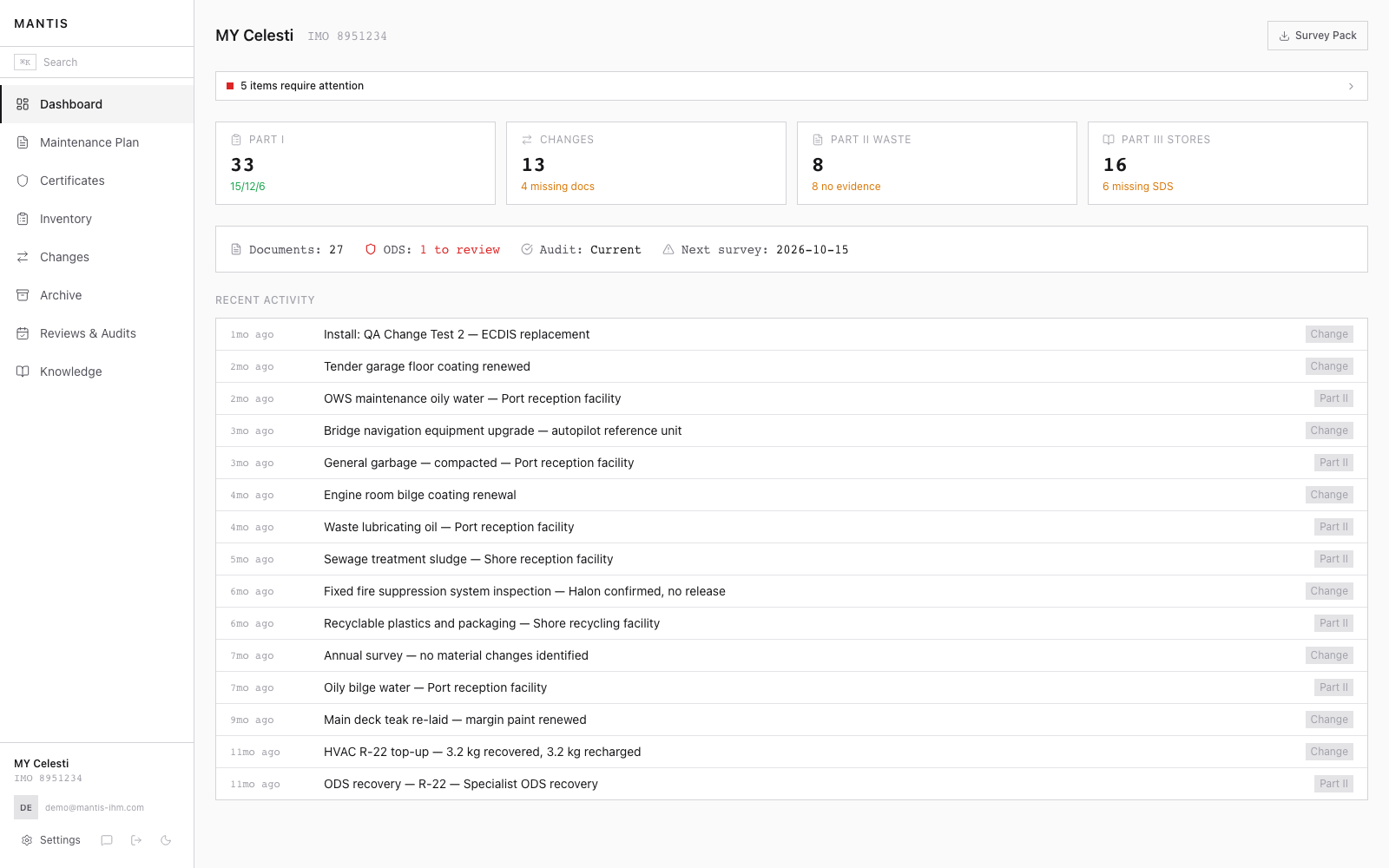
Class tools can be useful. They sit close to the reviewer, use familiar terminology, and may fit a vessel that stays inside one class ecosystem. But an operator’s IHM record has a broader job than satisfying one portal.
The underlying record has to survive class reviews, flag questions, PSC checks, management reporting, vessel handover, and sometimes a change of class or manager.
Quick answer
Use a class-specific tool when it makes a particular class review easier. Use independent IHM software when the operator needs one live, class-agnostic vessel record across mixed vessels, suppliers, managers, flags, and review situations.
What class tools are good at
Class-specific tools often work well when:
- The vessel is classed with that society
- The workflow is tied to that class’s review process
- The fleet is not mixed
- The operator wants one route into that class ecosystem
For a single-class fleet, this can reduce friction.
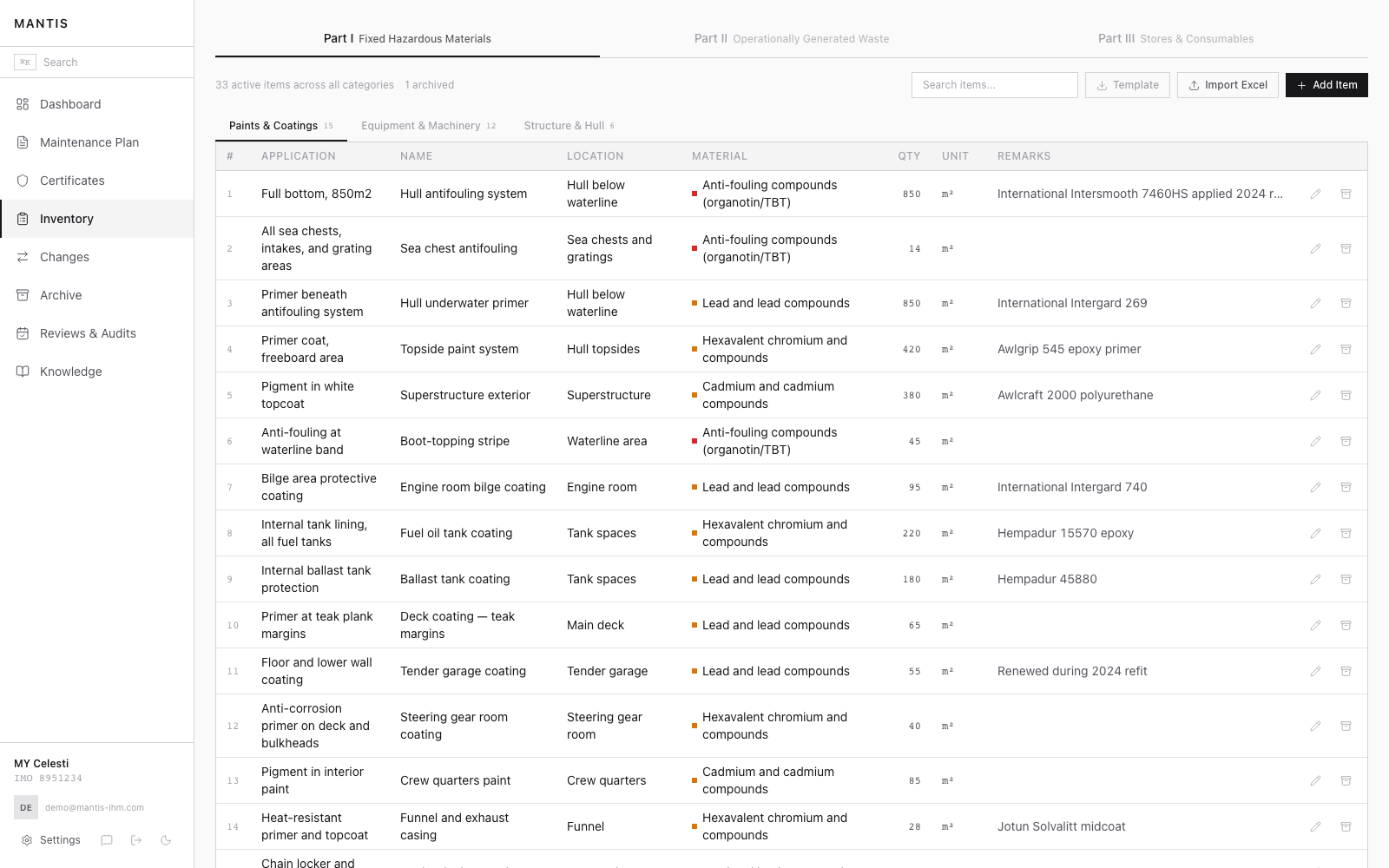
Where independent software fits
Independent IHM software fits when the operator needs control of the live record across contexts:
| Need | Why independent software helps |
|---|---|
| Mixed class or mixed flag vessels | One workflow across the fleet |
| Supplier MD/SDoC collection | Evidence workflow is operator-owned |
| Internal management reporting | Same record supports office review |
| PSC preparation | Export evidence without portal dependency |
| Handover | Record stays with the vessel/team |
The point is not to replace class. Class and flag remain responsible for verification. The point is to keep the operational record clean before anyone asks to review it.
Avoid portal lock-in
An IHM record is a long-life compliance asset. It should not become unusable because the vessel changes class, changes manager, or needs to present evidence outside a particular platform.
Ask whether the system lets you:
- Export the current record
- Export supporting evidence
- Keep a clear audit trail
- Work across all vessels
- Invite suppliers without forcing them into your internal account
If not, the tool may solve a narrow review problem while leaving the operator’s maintenance problem untouched.
Common decision mistakes
| Mistake | Why it creates risk |
|---|---|
| Choosing only for the next class review | The record still has to support PSC, flag, management, and handover. |
| Treating the portal as the source record | Evidence can become hard to export or reuse outside that ecosystem. |
| Ignoring mixed-fleet reality | Different vessels may need different review pathways but the same office workflow. |
| Forgetting supplier evidence | A clean certificate view does not solve MD/SDoC collection by itself. |
The practical answer
Use class tools when they help the review. Use independent IHM software to maintain the vessel’s live record day to day.
The cleaner the operator-owned record is, the easier every class, flag, PSC, or management conversation becomes.
Related reading:
Keep the live IHM record outside a single portal.
MANTIS is class-agnostic IHM software. It helps operators maintain the live record, collect supplier evidence, track certificates, and export survey-ready proof.
Request demo