
Spreadsheets can hold an IHM record. The problem is not the grid. The problem is everything around it: evidence, version control, supplier declarations, certificate dates, survey exports, and handover between people.
For a vessel with few changes and one careful owner, a spreadsheet can survive for a while. For an active vessel, a refit-heavy vessel, or a small fleet, the weak points show quickly.
Quick answer
Spreadsheets are acceptable for a static list, but they are weak for live IHM maintenance. Move to IHM software when you need attached supplier evidence, audit history, certificate tracking, repeatable survey packs, and handover resilience.
Where spreadsheets work
A spreadsheet is useful when the job is static:
| Need | Spreadsheet fit |
|---|---|
| List current Part I entries | Good enough |
| Sort/filter by location or material | Good enough |
| Quick offline viewing | Good |
| One-off initial compilation | Sometimes useful |
The spreadsheet is not the enemy. It is a familiar format for structured records.
Where spreadsheets fail
IHM maintenance is not only a list. It is a chain of evidence.
| Need | Spreadsheet problem |
|---|---|
| Attach MD/SDoC evidence to each change | Files sit elsewhere |
| Track who changed a record and when | Manual discipline required |
| Manage certificate/survey dates | Separate calendar or reminders |
| Request supplier evidence | Email chasing |
| Export a survey pack | Manual assembly |
| Handover to new crew/manager | Context lost |
The failure usually appears at review time. The inventory entry exists, but the supporting declaration is in a yard email, an old folder, or someone’s personal mailbox.
Common spreadsheet mistakes
- Treating the latest spreadsheet as proof without checking the linked evidence.
- Keeping the file current but leaving supplier documents in separate folders.
- Letting each vessel use different column names and review habits.
- Rebuilding survey exports manually every time.
- Assuming the spreadsheet will survive crew and manager handovers without context loss.
Spreadsheet risk checklist
| Risk | Typical symptom |
|---|---|
| Version drift | Nobody is sure which file is current. |
| Evidence drift | The Part I entry exists but the MD/SDoC is elsewhere. |
| Owner drift | The person who understood the file has left the vessel or office. |
| Date drift | Certificate or survey dates live in a separate calendar. |
| Export drift | Every review pack is rebuilt by hand. |
The real cost
The cost of spreadsheet-based IHM maintenance is not typing into cells. It is the time spent proving the cells are true.
That means:
- Reconstructing what changed during a refit
- Matching a declaration to a specific inventory entry
- Checking which version is current
- Rebuilding the same survey pack for each reviewer
- Explaining the record after the person who maintained it has left
Software earns its place when it reduces that proof burden.
When to move
Move from spreadsheets to IHM software when:
- The vessel is over 500 GT and in active service
- Refit or equipment changes happen regularly
- Supplier evidence is scattered across inboxes
- More than one person touches the record
- A fleet manager needs consistent records across vessels
- Survey preparation takes days instead of minutes
You can still export to spreadsheet when needed. The difference is that the working record should live in a system that keeps the evidence, dates, and audit trail attached.
Related reading:
Move from static rows to a live vessel record.
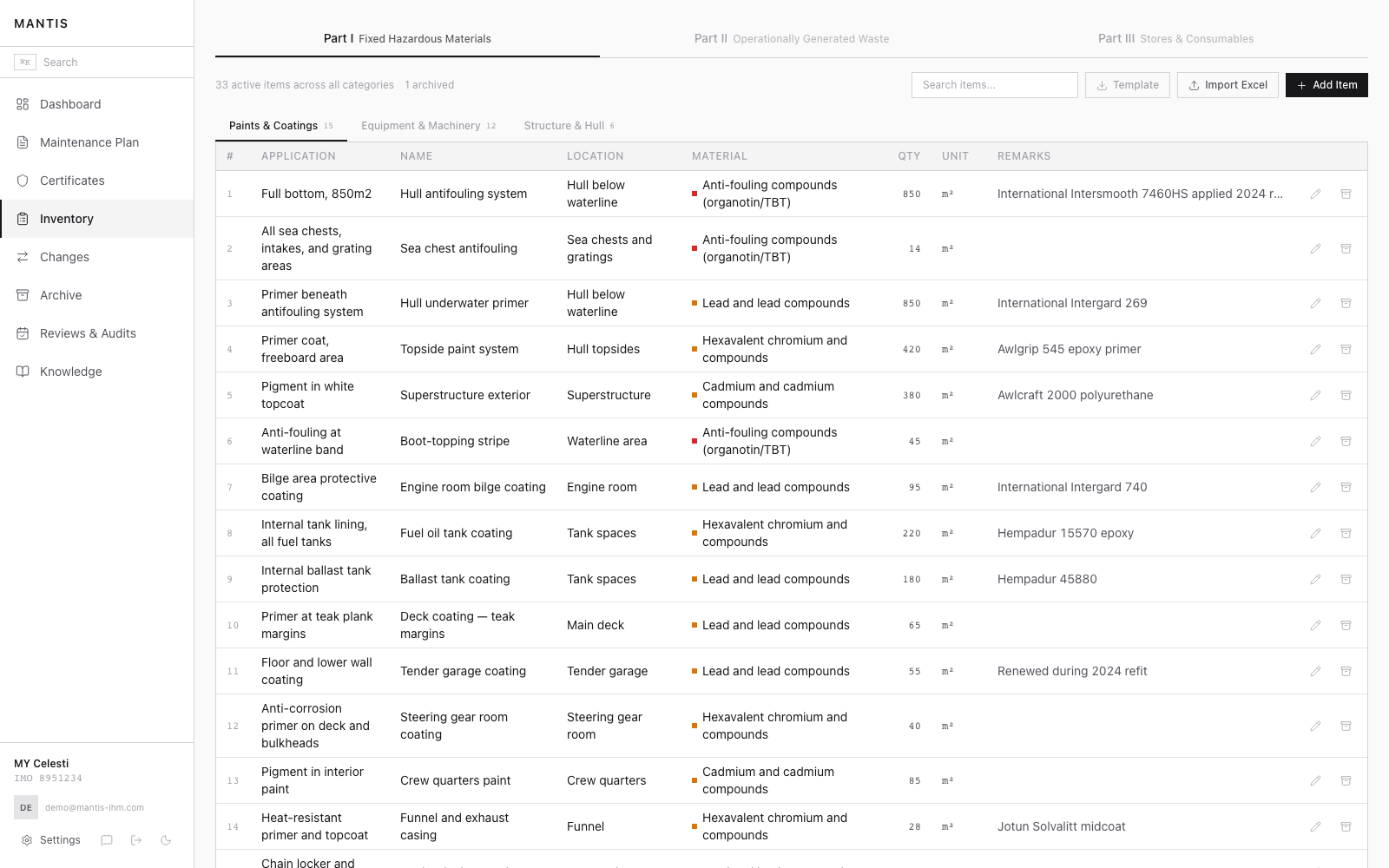
MANTIS replaces fragile IHM spreadsheets with a live vessel record: Part I changes, supplier evidence, certificate tracking, audit trail, and exports.
Request demo