
Refrigeration and air conditioning systems are one of the most common sources of IHM change records on an operational vessel. Refrigerant gases are ozone-depleting substances (ODS) listed in Annex I, Table A of the Hong Kong Convention — and whenever those systems are serviced, recharged, or replaced, the IHM may need to be updated.
This post explains the dual regulatory framework that applies to ODS on board, and what it means in practice for IHM maintenance.
Quick answer
Refrigerant work can affect both the IHM Part I record and MARPOL Annex VI ODS records. For every service event, record the refrigerant type and quantity, update Part I if an ODS is added, removed, or changed, and keep the contractor report as evidence.
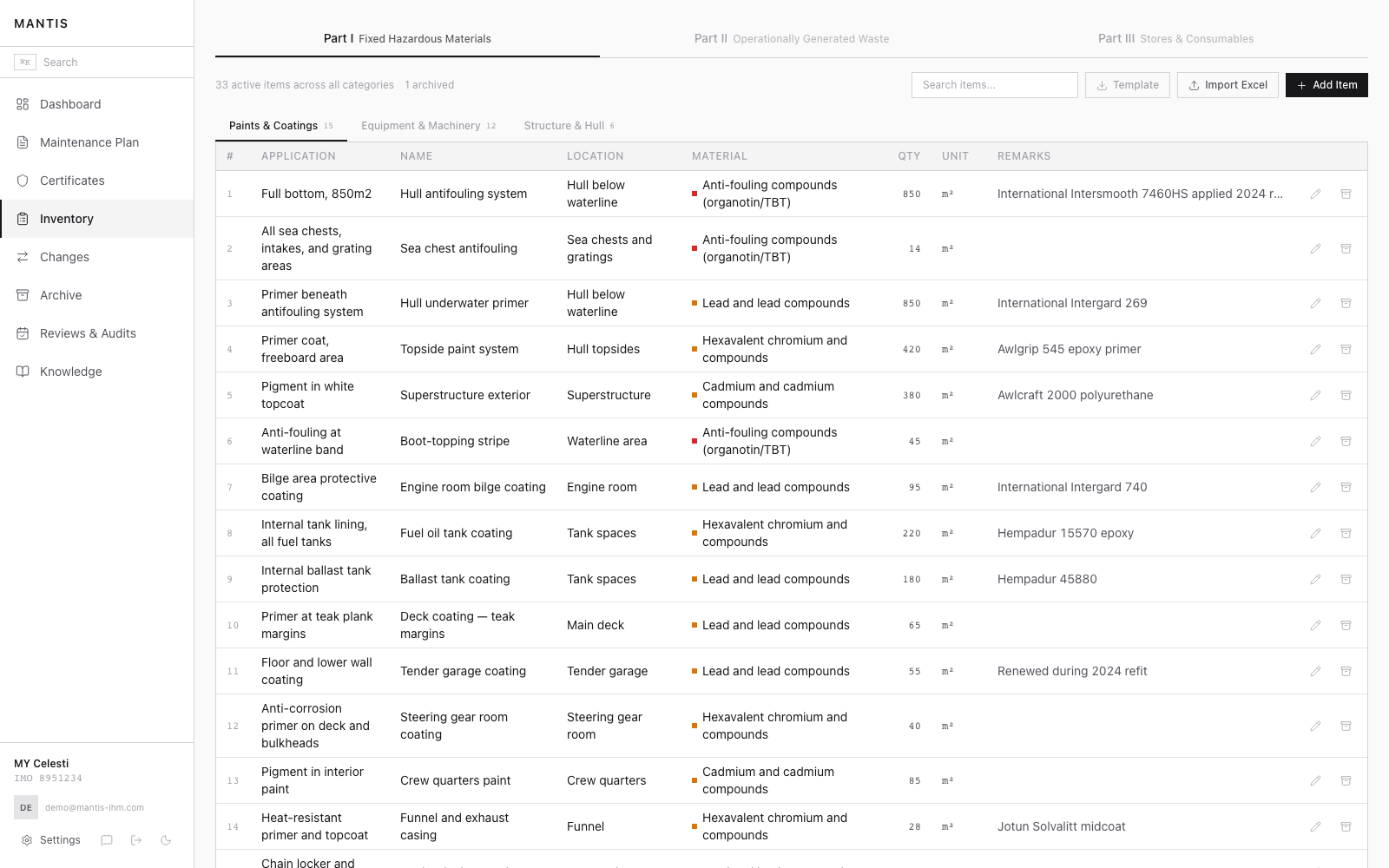
Two regulatory frameworks
ODS on board a vessel sit under two separate regulatory regimes:
The Hong Kong Convention lists ozone-depleting substances in Annex I, Table A. This means any ODS present in the vessel’s refrigeration or air conditioning systems must be recorded in Part I of the IHM. Changes — refrigerant top-ups, system replacements, removal of ODS-containing equipment — trigger a Part I update and require documentation from the contractor.
MARPOL Annex VI, Regulation 12 governs deliberate emissions of ODS from ship systems and sets requirements for ODS record-keeping. Regulation 12 requires ships to maintain a list of equipment containing ODS and a record book of ODS additions and removals. For refrigerating and air-conditioning equipment, additions must be recorded with the quantity recharged; for fire-protection equipment, the same record requirements apply.
These are separate instruments with separate compliance requirements. Meeting one does not automatically satisfy the other — but the underlying documentation largely overlaps.
What counts as an ODS under HKC Annex I
The controlled substances listed in HKC Annex I include the refrigerant types that have been subject to phase-out under the Montreal Protocol. The most relevant for operational vessels are:
- Chlorofluorocarbons (CFCs) — R-11, R-12, R-113, R-114, R-115 and their blends. These were common in older marine refrigeration and have been phased out of production.
- Hydrochlorofluorocarbons (HCFCs) — R-22, R-123, R-124, R-141b, R-142b. R-22 in particular was widely used in marine HVAC systems and is in the HKC Annex I list.
- Halons — used in fire suppression systems. Halon 1211, Halon 1301, and Halon 2402 are listed in HKC Annex I.
Refrigerants outside this list — including R-134a, R-407C, R-410A, and the R-32 blends increasingly used in newer systems — are hydrofluorocarbons (HFCs). HFCs are not ODS and are not listed in HKC Annex I (though they are subject to other regulation, including the Kigali Amendment to the Montreal Protocol and EU F-gas regulation where applicable). If your vessel has been retrofitted with an HFC refrigerant, and the IHM was updated at the time of conversion, the ODS entry for the original refrigerant should have been removed.
What triggers a Part I update
Under the Hong Kong Convention, Part I must be updated when an Annex I substance is added, removed, or changed. For ODS in refrigeration systems, this means:
Top-up recharge of an ODS refrigerant — if an existing system is recharged with additional ODS refrigerant, the quantity in Part I should be updated to reflect the current charge. The service contractor should provide documentation of the quantity added.
Refrigerant conversion — if a system is converted from an ODS refrigerant to a non-ODS alternative, the ODS entry should be removed from Part I and the change recorded with supporting contractor documentation.
System replacement — if an ODS-containing system is removed and replaced with new equipment using a non-ODS refrigerant, the ODS entry is removed and, if the new system contains any Annex I substances, a new entry is added.
New ODS installation — uncommon for newer vessels, but if ODS-containing equipment is installed, a new Part I entry is required.
For each of these events, the service contractor or equipment supplier should provide either a Material Declaration (confirming ODS content and quantity) or a Supplier’s Declaration of Conformity (confirming no Annex I content). This documentation is filed alongside the change record.
The MARPOL Annex VI record book
Separately from the IHM, MARPOL Annex VI Regulation 12 requires vessels with ODS-containing equipment to maintain a record of additions and removals. The required information for each entry includes the date, the equipment identity, the type of ODS, and the quantity added or removed.
This record is inspected by Port State Control as part of a MARPOL Annex VI inspection. It is distinct from the IHM but overlaps substantially with the Part I change record. In practice, a well-maintained IHM change log that captures ODS additions and removals with contractor documentation will contain most of what the MARPOL Annex VI record book requires — but the two records serve different regulatory purposes and both should be maintained.
Refrigerant service checklist
| Service event | IHM action |
|---|---|
| ODS top-up | Update quantity and attach service report. |
| ODS removal | Update or remove Part I entry and record removed quantity. |
| Conversion to non-ODS refrigerant | Close out old ODS entry and attach conversion evidence. |
| System replacement | Review old and new systems for controlled materials. |
| Non-ODS service | Keep evidence showing why no Part I ODS update was required. |
A practical approach
For Chief Engineers managing active refrigeration systems, the simplest approach is to treat every refrigerant service event as a documentation trigger:
- Before the work — confirm what refrigerant type the system uses and whether it is an ODS. If it is, a Part I update will be needed.
- During the work — request a service report from the refrigeration engineer noting the refrigerant type and quantity added or removed.
- After the work — update the IHM Part I entry and the MARPOL Annex VI record book; file the service report as supporting documentation for both.
This discipline takes minutes per service event and creates a complete record. The alternative — reconstructing the history of a refrigeration system’s service record from memory at the time of a survey — is unreliable and leaves gaps that are difficult to close after the fact.
Common refrigerant record mistakes
- Updating the MARPOL ODS record but not the IHM Part I entry.
- Recording a service event without refrigerant type or quantity.
- Removing old equipment without closing the related IHM entry.
- Treating every refrigerant as an ODS without checking the substance.
- Filing the contractor report away from the IHM change record.
For the wider change-control process, see maintaining IHM Part I.
Related reading:
Keep refrigerant changes visible in the IHM record.
MANTIS manages Part I change records with linked documentation for each service event.
Request demo